Integration between Power BI Dashboards and Multiple Data Sources in Organizations Operating in Syria: Towards Evidence-Based Decision Making
- The importance of data integration for improving decision-making in Syrian institutions.
- How Power BI helps address the challenges of data fragmentation.
- Practical steps for effectively implementing integration in organizations.
- The benefits of using Power BI to enhance institutional efficiency.
- The role of “Insight Syria” in supporting the digital transformation of organizations.
Table of Contents
- Introduction: The Documentary and Informational Reality in the Syrian Institutional Environment
- What is the integration between Power BI Dashboards and Multiple Data Sources in Organizations Operating in Syria?
- The challenges facing organizations in Syria and how integration with Power BI solves them
- Practical steps towards efficient integration implementation
- Qualitative benefits for governmental and non-governmental organizations in Syria when using Power BI
- The role of “Insight Syria” in leading this digital transformation
- Conclusion and Recommendations for Managers and Decision Makers
Introduction: The Documentary and Informational Reality in the Syrian Institutional Environment
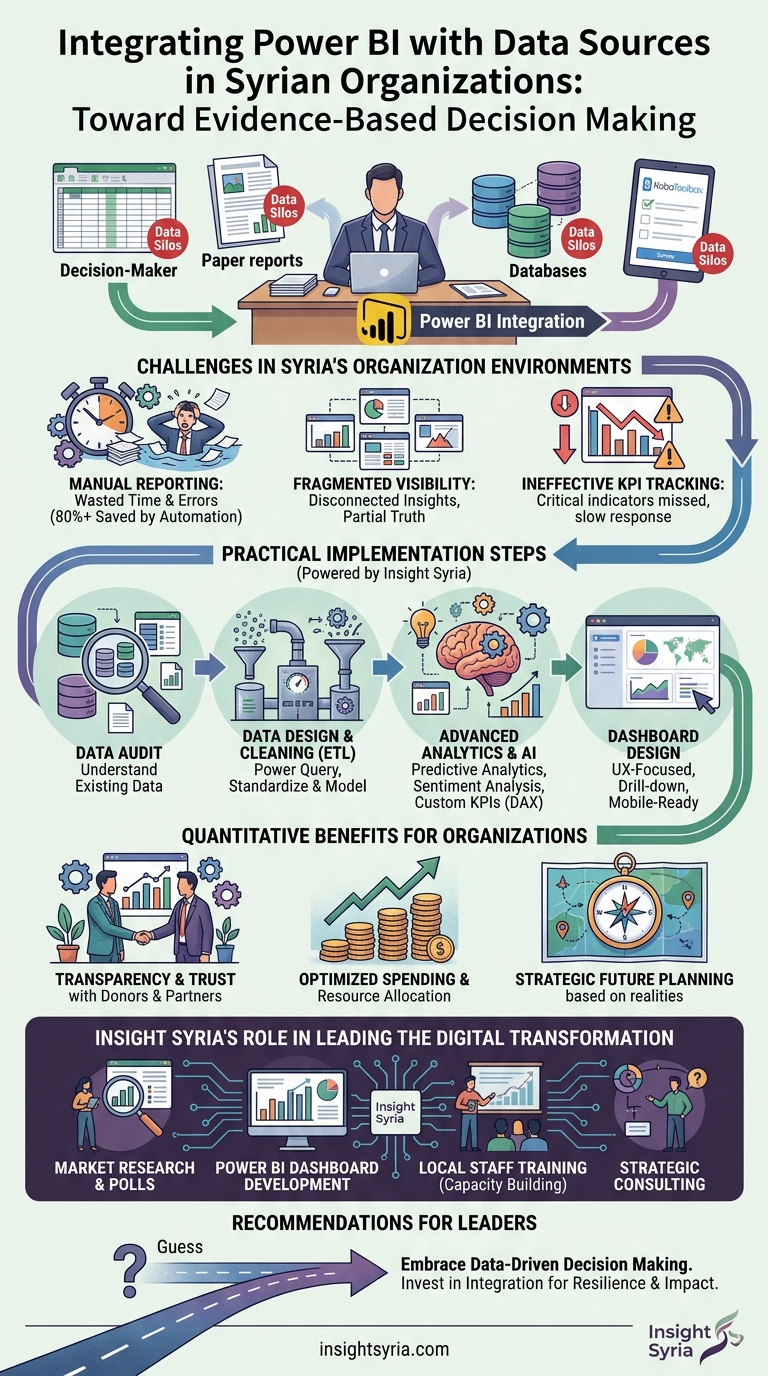
Organizations operating in Syria face unique challenges; they deal with a rapidly changing economic environment, fluctuations in supply chains, and an ongoing need to evaluate humanitarian and developmental projects or assess beneficiary and market satisfaction. Often, these organizations find their data scattered across different systems: traditional Excel spreadsheets, fragmented SQL databases, paper reports, digital field surveys (such as KoboToolbox or ODK), and independent financial and management systems.
This fragmentation creates what is known as “data silos,” where each department or section operates in isolation from the others, hindering a comprehensive view for senior management. Herein lies the essential role of the integration between Power BI Dashboards and Multiple Data Sources in Organizations Operating in Syria, as Microsoft’s Power BI tool acts as a nervous bridge connecting these disparate sources into a single, interactive, and real-time visual interface.
What is the integration between Power BI Dashboards and Multiple Data Sources in Organizations Operating in Syria?
To understand the technical and administrative depth of this process, we must define “integration” as the process of linking various technical mechanisms for collecting and storing data with the Power BI business intelligence platform, allowing the platform to automatically pull data from its original sources without continuous manual intervention, and perform data cleaning and modeling operations, ultimately presenting the results in the form of dashboards and interactive reports.
In the Syrian context, this integration requires extreme flexibility due to varying technical infrastructure and occasional internet outages, prompting data analysis teams to design smart information flow paths (Data Pipelines) capable of effective synchronization when connectivity is available.
The challenges facing organizations in Syria and how integration with Power BI solves them
Many governmental entities, humanitarian organizations, and commercial companies in Syria face similar challenges concerning data management. The main challenges and how they can be addressed through integration between Power BI Dashboards and Multiple Data Sources in Organizations Operating in Syria can be summarized as follows:
1. Wasted time in manual report preparation
Administrative teams in many institutions often spend an entire week at the end of each month gathering data from various branches, copying and pasting it into Excel tables, and formatting it. This approach is not only time-wasting but also prone to deadly human errors.
Solution: With Power BI, this process is fully automated. Once data is entered into its sources, the dashboards update themselves automatically, saving more than 80% of wasted time and allowing teams to focus on analysis and decision-making instead of routine tasks.
2. Lack of a unified view for decision makers
The human resources department may have accurate data, the operations department may have different data, and the finance department may have another set of data. Without linking this data, the manager makes decisions based on part of the truth, not the whole truth.
Solution: Integrating multiple sources (SQL, Excel, Web APIs, Cloud Files) into a single Power BI dashboard provides a comprehensive 360-degree view, allowing the executive director or governmental official to see the intersection between the budget, field performance rates, and logistical challenges on a single screen.
3. Difficulty in effectively tracking Key Performance Indicators (KPIs)
Organizations need to monitor sensitive performance indicators moment by moment, especially in rapidly changing relief or commercial projects.
Solution: Power BI dashboards enable users to create visual performance indicators that alert management immediately if any indicator deviates from the planned path, through a system of flexible alerts and programmed notifications.
Practical steps towards efficient integration implementation
At “Insight Syria”, we follow a scientific and deliberate methodology to assist our clients from organizations and governmental entities in maximizing the benefits of integration between Power BI Dashboards and Multiple Data Sources in Organizations Operating in Syria. This methodology is divided into several essential phases:
Phase One: Data Audit and Understanding Sources
A successful business intelligence system cannot be built without a precise understanding of what data the organization possesses. We study all available data sources within the organization:
- Project databases.
- Field surveys (whether paper-based entered digitally or directly digital).
- Financial and accounting data.
- Open data and previous studies on the Syrian market and economic situation.
Phase Two: Data Structuring and Cleaning (ETL Process)
Raw data is often unstructured or contains errors and duplicates. We use embedded Extract, Transform, Load (ETL) tools in Power BI (such as Power Query) to standardize date formats, remove missing values, and link tables through precise logical relationships that ensure accuracy in the results later.
Phase Three: Building Advanced Analytical Models Supported by Artificial Intelligence
Our role extends beyond merely displaying numbers; we go further by integrating artificial intelligence capabilities into Power BI. This phase includes:
- Using predictive analytics to anticipate future market trends or beneficiaries’ needs in specific areas.
- Applying sentiment analysis to public or beneficiary feedback collected through surveys.
- Creating custom calculations using the analytics language (DAX) to extract complex indicators not visible in raw data.
Phase Four: User Interface and Dashboard Design
We believe that the best analytical algorithm fails if it is not understood quickly by the human eye. Therefore, we design dashboards according to the highest standards of user experience (UX), considering simplicity, color clarity, and the ability to drill-down interactively, so that ministers, general managers, or project managers can browse data via computers or smartphones and make confident decisions in seconds.
Qualitative benefits for governmental and non-governmental organizations in Syria when using Power BI
Adopting the techniques of integration between Power BI Dashboards and Multiple Data Sources in Organizations Operating in Syria gives institutions tremendous competitive and managerial advantages, contributing to enhancing donor trust, improving public service quality, and shaping public policies based on solid facts. Here are the details of these benefits:
1. Enhancing transparency and building trust with donors and partners
International and local organizations working in humanitarian and developmental affairs in Syria need to demonstrate the impact of their interventions with complete transparency. Providing interactive, up-to-date dashboards that can be shared (with specific security permissions) with donors enhances the organization’s credibility, facilitates auditing and monitoring processes, and ensures funding sustainability.
2. Streamlining expenditures and improving resource allocation efficiency
In light of economic challenges, financial resources are scarce and valuable. Integrated data analysis helps pinpoint areas that need urgent interventions with astonishing accuracy, preventing waste of funds on unproductive projects and directing financial and logistical support toward the most needy sectors or groups.
3. Supporting future strategic planning
Data analyses do not only focus on the past; they extend to reading the future. By integrating historical data from several years with current market indicators, departments can plan for the coming years carefully and appropriately to the changing Syrian reality.
The role of “Insight Syria” in leading this digital transformation
As leaders in market research, opinion surveys, and data analytics within the local environment, we at Insight Syria fully understand the intricate details that govern organizations’ work here. We do not provide ready-made, imported technical solutions that do not fit the reality; rather, we design integrated service packages that combine deep research expertise with the latest global technology tools like Power BI.
We assist our partners from ministries, government agencies, international and local organizations, and major companies in:
- Conducting high-precision market research and field surveys, transforming their outputs into integrated digital databases.
- Building and developing fully customized Power BI dashboards to meet the unique needs of each institution.
- Training and qualifying local staff within organizations on using these tools, ensuring sustainability of work and building local capacities.
- Providing strategic consultations based on deep data analyses, which helps senior management formulate effective policies.
Conclusion and Recommendations for Managers and Decision Makers
The era of making decisions based on intuition and guesswork has ended irrevocably. In the complex environment in which Syrian institutions operate today, the need to shift towards a data-driven decision-making culture is urgent.
The integration between Power BI Dashboards and Multiple Data Sources in Organizations Operating in Syria is an indispensable strategic step for any organizational leader aspiring to achieve efficiency, transparency, and sustainable growth. Investing in data linkage and analysis is an investment in the future of the institution and its ability to endure and have a positive impact on society.
We at Insight Syria invite all managers, decision-makers, and policymakers in governmental and various organizations to contact us today to explore how our services in data analysis and system integration can create a qualitative change in the efficiency of your operations, and let us work together towards building a future based on facts and precise evidence in Syria.