Economic and Social Impact Studies of Development and Reconstruction: The Compass for Sustainable Recovery in Syria
- Reconstruction and sustainable development are a necessity for building infrastructure and stimulating the economy.
- Impact studies as an effective tool to ensure proper resource allocation.
- Accurate data analysis contributes to fact-based decision making.
- The importance of these studies in supporting government efforts and international organizations.
- Identifying vital sectors that require effective intervention for impact studies.
Table of Contents
- What are Economic and Social Impact Studies? And what is their importance in the Syrian context?
- Why do government entities and organizations need systematic impact studies?
- The methodology at “Insight Syria”: How do we turn data into actionable insights?
- Vital sectors needing impact studies in Syria today
- The challenges facing impact assessment in Syria and how “Insight Syria” overcomes them
- How do impact studies help attract international funding and donors?
- The vision of “Insight Syria”: A true partnership towards a better future
What are Economic and Social Impact Studies? And what is their importance in the Syrian context?
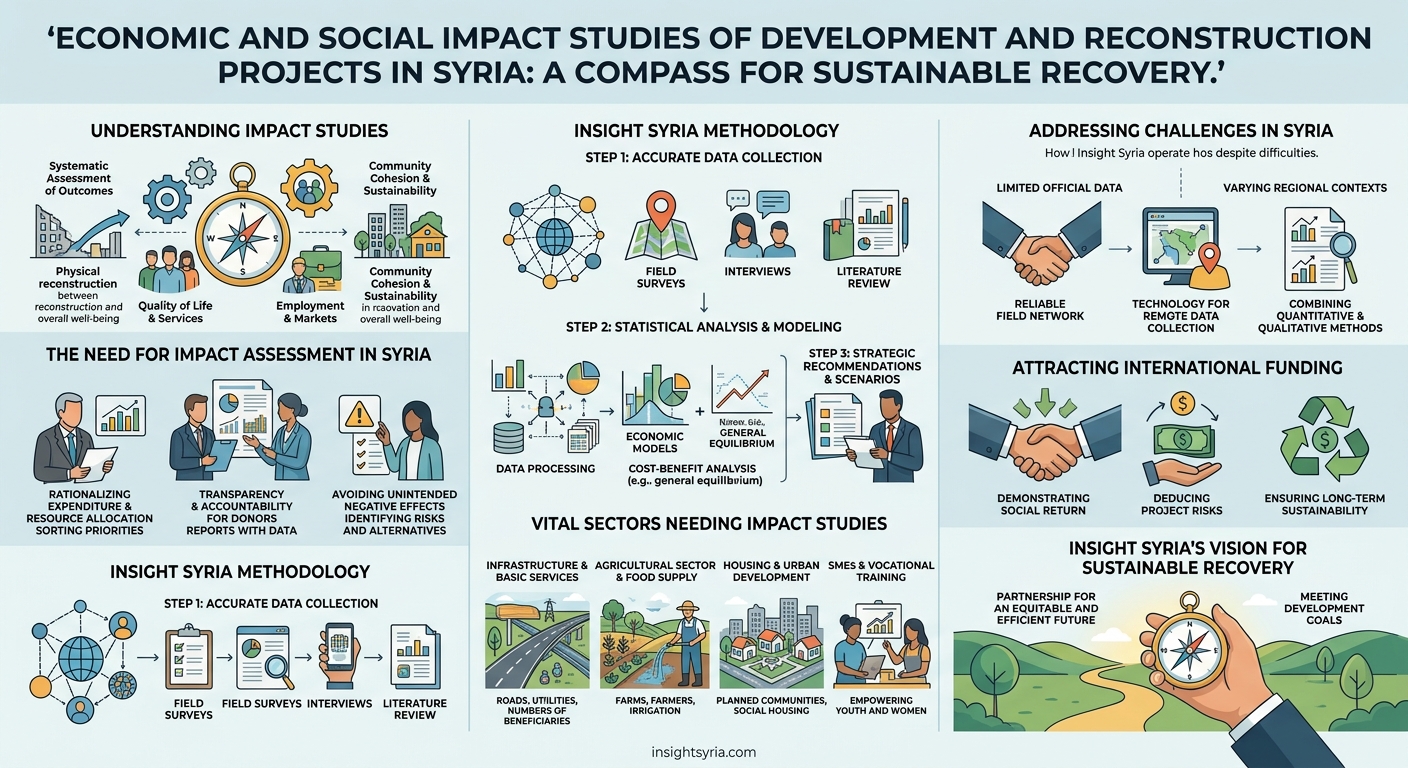
Economic and social impact studies for development and reconstruction projects are defined as the systematic evaluation and forecasting of long-term and short-term outcomes resulting from the implementation of a specific project or policy. These studies do not only measure pure financial returns but also encompass changes in individuals’ quality of life, employment levels, availability of essential services, cohesion of local communities, and environmental sustainability.
In the Syrian context, these studies take on exceptional dimensions given the magnitude of destruction affecting various sectors. Launching reconstruction projects without a precise understanding of their economic and social backgrounds could lead to wasted resources or exacerbate developmental disparities among regions.
Key dimensions of impact studies:
- Direct and indirect economic impact: Measuring the scale of job opportunities created and stimulating local markets.
- Social and human impact: Assessing how the project contributes to poverty reduction and improving access to services.
- Institutional and governmental impact: Assisting decision-makers in crafting policies more efficiently.
Why do government entities and organizations need systematic impact studies?
Government institutions and international NGOs in Syria recognize that the developmental challenges are immense while financial resources are limited. Thus, relying on evaluations of development and reconstruction projects is no longer a mere administrative luxury but a prerequisite for success.
1. Rationalizing spending and improving resource allocation
The current situation requires all efforts to be spent on genuinely viable projects. Economic and social feasibility studies help prioritize projects.
2. Ensuring transparency and accountability
Donors require transparent reports based on digital evidence. Accurate numbers and statistical analyses provide a solid foundation for progress reports.
3. Avoiding unintended negative impacts
Some projects may lead to adverse outcomes if not studied carefully. Proactive studies identify risks early and set alternative plans.
The methodology at “Insight Syria”: How do we turn data into actionable insights?
We rely on a comprehensive scientific methodology to provide economic and social impact studies for development and reconstruction projects, which goes through several stages:
Step 1: Collecting primary and secondary data with utmost accuracy
- Field surveys and opinion polls: Designing scientific questionnaires in collaboration with reliable field teams.
- Interviews with key stakeholders: Conducting interviews with officials and community leaders.
- Review of existing literature and historical data: Analyzing available economic and social indicators.
Step 2: Statistical analysis and economic modeling
Our team uses statistical tools to process data and extract key performance indicators. These analyses include:
- computable general equilibrium models.
- Social cost and benefit analysis.
- Market feasibility studies and consumer behavior.
Step 3: Formulating strategic recommendations and scenario planning
We translate data into actionable recommendations directed at ministries, government entities, and donors.
Vital sectors needing impact studies in Syria today
Reconstruction and development in Syria require simultaneous intervention in multiple sectors. There is an urgent need for impact studies in the following areas:
1. Infrastructure and essential services sector
Rehabilitating networks requires an accurate study of the number of beneficiaries and operating costs.
2. Agricultural sector and food supply chains
Agriculture is a fundamental pillar, and impact studies are essential to support farmers and rehabilitate networks.
3. Housing and urban development
Providing accurate assessments for social housing projects and how to organize urban expansion.
4. Small and medium enterprises (SMEs) sector
Studies measuring the impact of micro-financing and vocational training programs on empowering youth and women.
The challenges facing impact assessment in Syria and how “Insight Syria” overcomes them
Research work in the Syrian environment suffers from a lack of official data and variations in geographical contexts. “Insight Syria” relies on flexible strategies:
- A reliable field network for collecting accurate primary data.
- Using technology for remote data collection.
- Combining quantitative and qualitative methodologies to ensure comprehensive reports.
How do impact studies help attract international funding and donors?
Evidence-based impact studies are a prerequisite for attracting donors. When projects are presented with supporting studies:
- The social return is clarified.
- Risks associated with projects are reduced.
- Contributing to ensuring long-term sustainability.
The vision of “Insight Syria”: A true partnership towards a better future
It must be emphasized that rebuilding Syria is a complex process that requires precise navigation. We are pleased to offer our services to government entities and international organizations to ensure that development goals are met efficiently and justly.
We invite you today to connect with our expert team to discuss how our services can support your upcoming projects and ensure them the highest levels of success and sustainable impact.