Performance Evaluation of Field Teams in Data Collection through Smart and Automated Indicators: A Guide for Institutions towards Efficiency and Reliability
- The necessity of having accurate and reliable data in an era of rapid economic and social changes.
- Evaluating the performance of field teams is the cornerstone of any economic study or opinion survey.
- Using smart and automated indicators to improve the efficiency and quality of field data.
- Providing innovative technological systems to facilitate data collection and analysis.
- Overcoming logistical and human challenges by developing precise performance indicators.
Table of Contents
- Why are Field Teams the Critical Link in the Data Chain?
- The Comprehensive Concept of Evaluating Field Teams’ Performance in Data Collection through Smart and Automated Indicators
- The Core Pillars of Smart Indicators in Field Evaluation
- The Role of Artificial Intelligence and Data Analytics in Developing the Field System
- Practical Steps for Implementing a Smart and Automated Evaluation System for Field Teams
- Case Study and Practical Benefit: How Did “Insight Syria” Succeed in Enhancing Data Reliability?
- Benefits of Adopting Automated Indicators for Governments and Major Organizations
- Challenges and How to Overcome Them in the Field Work Environment
- Partnership with “Insight Syria”: Your Gateway to Reliable and Smart Research Data
Why are Field Teams the Critical Link in the Data Chain?
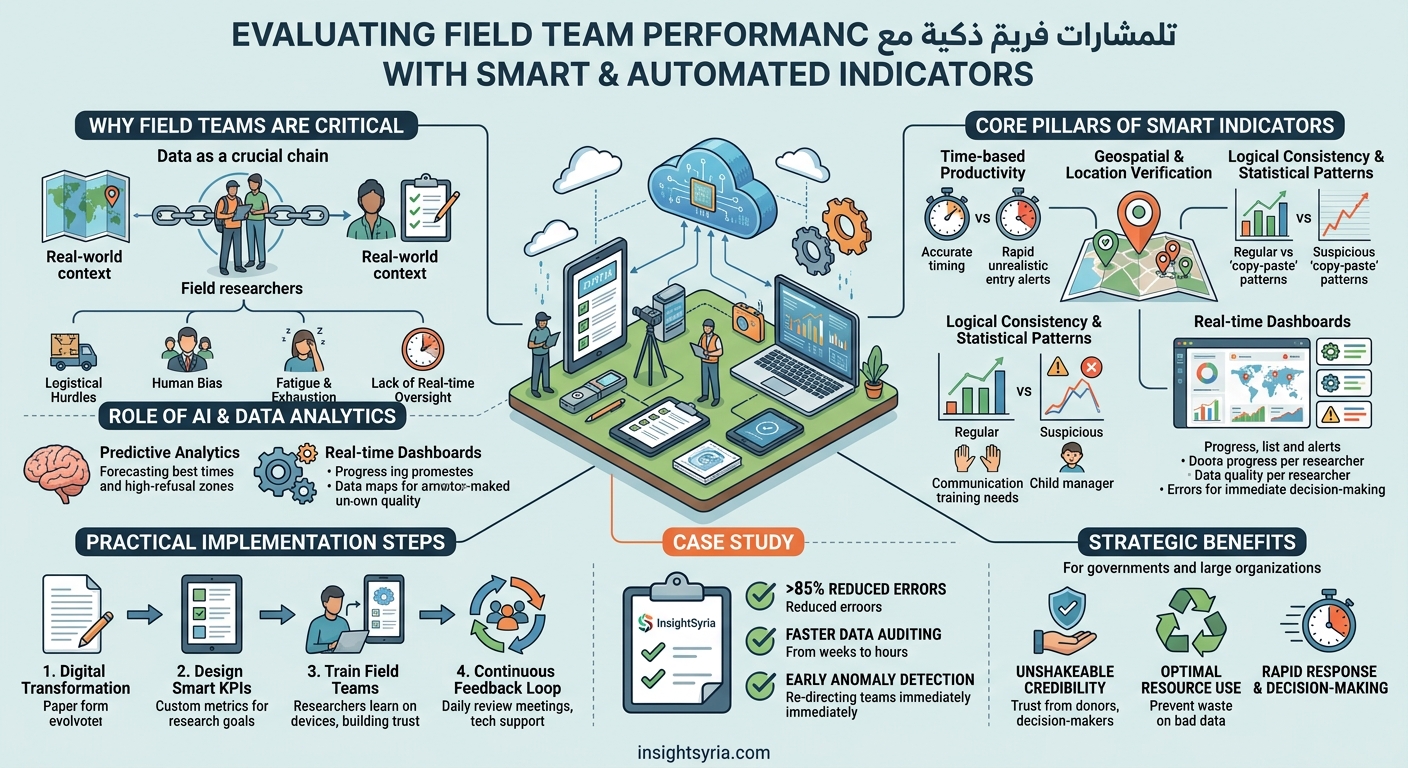
Before diving into the details of smart indicators, we must recognize the value of the field researcher and the teams that traverse the field extensively. They are the true eyes and ears of the institution on the ground. Whether the goal is measuring sustainable development indicators, assessing the impact of a humanitarian project, or surveying consumer opinions about a product or service, the quality of the outputs entirely depends on the quality of human and technical performance in the field.
However, field teams usually face significant challenges, including:
- Logistical and Geographic Challenges: Difficulty accessing certain areas, changing weather, or security conditions.
- Human Bias: Some researchers may consciously or unconsciously steer questions in a way that affects respondents’ answers, or they may shorten interviews to save time.
- Fatigue and Exhaustion: Fieldwork is arduous and demanding, which may lead to errors in data recording or neglecting some finer details.
- Lack of Effective Supervision: In traditional methods, errors or data manipulation are discovered only after fieldwork ends and sometimes days or weeks later, making it impossible to correct the mistake or recollect the data.
This is precisely where the urgent need to transition to performance evaluation of field teams in data collection via smart and automated indicators emerges to ensure instantaneous monitoring, ongoing support, and rapid intervention to correct the course.
The Comprehensive Concept of Evaluating Field Teams’ Performance in Data Collection through Smart and Automated Indicators
When we talk about “smart and automated indicators”, we are not just referring to traditional data entry programs, but we discuss an integrated digital system that employs data analytics and artificial intelligence technologies to monitor the performance of field researchers moment by moment. This system relies on dynamic Key Performance Indicators (KPIs) that are automatically updated based on the flow of field data.
At “Insight Syria”, we have developed advanced frameworks that integrate digital data collection with real-time analytical tools. These frameworks allow supervisors and project managers to have a comprehensive view of fieldwork through interactive dashboards that accurately illustrate:
- Amount of completion against the planned timeline and spatial distribution.
- Quality of input data through automatic detection of suspicious patterns.
- Teams’ adherence to the ethical and methodological standards set.
The Core Pillars of Smart Indicators in Field Evaluation
To build an effective and automated performance evaluation system, focus must be on several core pillars that integrate with each other to provide an accurate and comprehensive picture:
1. Time-based Productivity Metrics
These metrics measure the time taken to complete each survey or field interview. It is known that each survey has a natural time significance; if a researcher takes only 3 minutes to complete a survey that typically requires 25 minutes, this is an immediate smart indicator that the researcher is either rushing responses or filling out the survey randomly without actual interviews. The automated indicators here trigger an immediate alert to the project manager to review the performance of that specific researcher.
2. Geospatial & Location Verification
Most modern data collection applications rely on Geographic Positioning (GPS Coordinates) and the time of the form submission. Smart indicators allow matching the coordinates reported by the researcher’s device with the digital maps of the study area. Was the researcher really in the specified neighborhood? Are there illogical clusters of multiple surveys sent at the same moment from the same geographic point? These questions are precisely answered by automated algorithms, preventing any spatial manipulation.
3. Logical Consistency & Statistical Patterns
Advanced analytical tools and artificial intelligence rely on examining the “statistical harmony” in respondents’ answers through one researcher’s forms. If the system notices that a certain researcher consistently gets matching answers (a copy-paste pattern) from respondents who are completely diverse in their demographic characteristics, the smart indicators classify this pattern as “anomalous” and put it under review. Logical inconsistencies are also examined, such as if the researcher records that the respondent is a 5-year-old child working as a company manager, a logical error that the system immediately detects.
4. Refusal and Attrition Rates
This indicator measures the proportion of individuals who refused to participate in the study or completed part of it and withdrew. A high refusal rate for a specific researcher compared to other team members may indicate poor communication skills, inappropriate questioning approaches, or misunderstanding of the study inputs. This indicator helps management direct immediate and quick training for the researcher to improve their communication skills.
The Role of Artificial Intelligence and Data Analytics in Developing the Field System
Transitioning from random human evaluation to evaluation through smart and automated indicators opens broad horizons for institutions to improve the quality of their research. Here comes the pivotal role of the accumulated experiences of the “Insight Syria” team in leveraging modern technological tools to serve the local context. Here’s how artificial intelligence and data analytics contribute in this context:
Predictive Performance Analytics
Smart indicators are not limited to evaluating what has occurred; they extend to predicting what will happen. By analyzing historical data from previous work teams, machine learning models can identify factors that lead to the success or failure of a specific field mission. For example, it can predict the best times for conducting interviews in a certain residential neighborhood based on daily movement patterns of residents, or anticipate areas that might experience high refusal rates and prepare alternative strategies in advance.
Real-time Dashboards
Paper reports that arrive after project completion are no longer useful in a rapidly changing world. Real-time dashboards for project managers in institutions and governments provide the ability to see the flow of field data by the second and minute. These dashboards display graphs that show the distribution of researchers, daily completion rates, quality indicators of data attributed to each researcher, and the most frequent errors. This enables decision-makers to intervene and adjust the work plan the same day instead of discovering a flaw too late.
Practical Steps for Implementing a Smart and Automated Evaluation System for Field Teams
To enable government institutions, NGOs, and major companies to effectively adopt this methodology, the experts at “Insight Syria” provide a well-planned and practical roadmap consisting of several key stages:
1. Digital Transformation of Data Collection Tools
The first step starts with completely abandoning paper forms and transitioning to digital platforms for data collection. These digital forms must include preconditions that prevent the researcher from skipping mandatory questions or entering values out of the acceptable range.
2. Smart KPI Design
It is essential to sit with data analysis teams and define the smart indicators that match the nature of the research goal and local context. There is no one-size-fits-all recipe; political opinion surveys have different requirements than economic surveys or field health studies.
3. Training and Preparing Field Teams on Digital Culture
Technology alone is not enough; the field researcher must understand that these smart indicators are not a “spy tool” against them, but rather a means to protect their efforts, ensure the integrity of the work, and facilitate their tasks. Building digital trust between management and field teams enhances work motivation and positively impacts the quality of outputs.
4. Building a Continuous Feedback Loop
Performance evaluation should shift from a punitive control process to a continuous learning and development process. Short daily meetings should be held to present performance indicators, discuss the field challenges faced by the teams, and provide immediate technical support to those researchers in need.
Case Study and Practical Benefit: How Did “Insight Syria” Succeed in Enhancing Data Reliability?
In our ongoing work within the Syrian market and the region, we have faced numerous challenges related to geographic diversity, varying infrastructures, and the urgent need for utmost precision in presenting data to decision-makers and international organizations.
By implementing performance evaluation systems for field teams in data collection via smart and automated indicators in one of the large economic survey projects, we were able to achieve the following:
- A reduction in errors and corrupted data by over 85% compared to traditional methods, thanks to pre-validation rules and instant alerts.
- Reducing the time for data review and auditing from weeks to just a few hours, enabling the client to receive their final reports in a timely manner.
- Early detection of cases of manipulation or human shortcomings on the very first day of field entry, allowing for immediate redirection and training of teams without losing the study sample.
Benefits of Adopting Automated Indicators for Governments and Major Organizations
When a government entity or international organization decides to invest in advanced systems to evaluate the performance of its field teams, it reaps long-term strategic returns, the most notable of which are:
- Building Unshakeable Credibility: Data based on rigorous methodologies and smart monitoring enjoy the trust of donors, the international community, and policymakers.
- Optimal Use of Financial and Human Resources: Smart indicators prevent wasting these resources on collecting contaminated or inaccurate data and direct effort to the most productive areas.
- Rapid Response and Decision Making: Automated indicators provide a smooth and reliable supply of confirmed information.
Challenges and How to Overcome Them in the Field Work Environment
Despite the many benefits, the implementation of smart evaluation systems faces some challenges that must be dealt with cautiously, including:
- Poor Communication and Internet Infrastructure: In some field areas, researchers may suffer from internet outages, hindering the immediate sending of data.
- Resistance to Change: Some veteran researchers may hesitate to abandon traditional methods.
Partnership with “Insight Syria”: Your Gateway to Reliable and Smart Research Data
Achieving institutional excellence and making decisions based on solid evidence is no longer a luxury; it is a vital necessity for survival and growth in complex, dynamic environments. Investing in performance evaluation of field teams in data collection via smart and automated indicators is the smartest investment for any government or organization seeking leadership and transparency.
At Insight Syria, we provide you with comprehensive expertise that combines our deep understanding of the local reality and regional context with the latest data analytics, opinion polls, and artificial intelligence technologies. We offer a comprehensive solution starting from study design, through managing and training field teams and developing smart performance indicators, all the way to delivering deep and actionable analyses.
We invite all institutional leaders, project managers, and policymakers in government entities and international organizations to contact us today. Let us help you turn field challenges into real opportunities and build an institutional future based on precision, reliability, and smart decision-making. Insight Syria… Your trusted partner for deeper insights and data that opens doors to the future.