
The Role of Artificial Intelligence in Developing the Education and Vocational Training Sector in Syria: Towards a Sustainable Digital Future
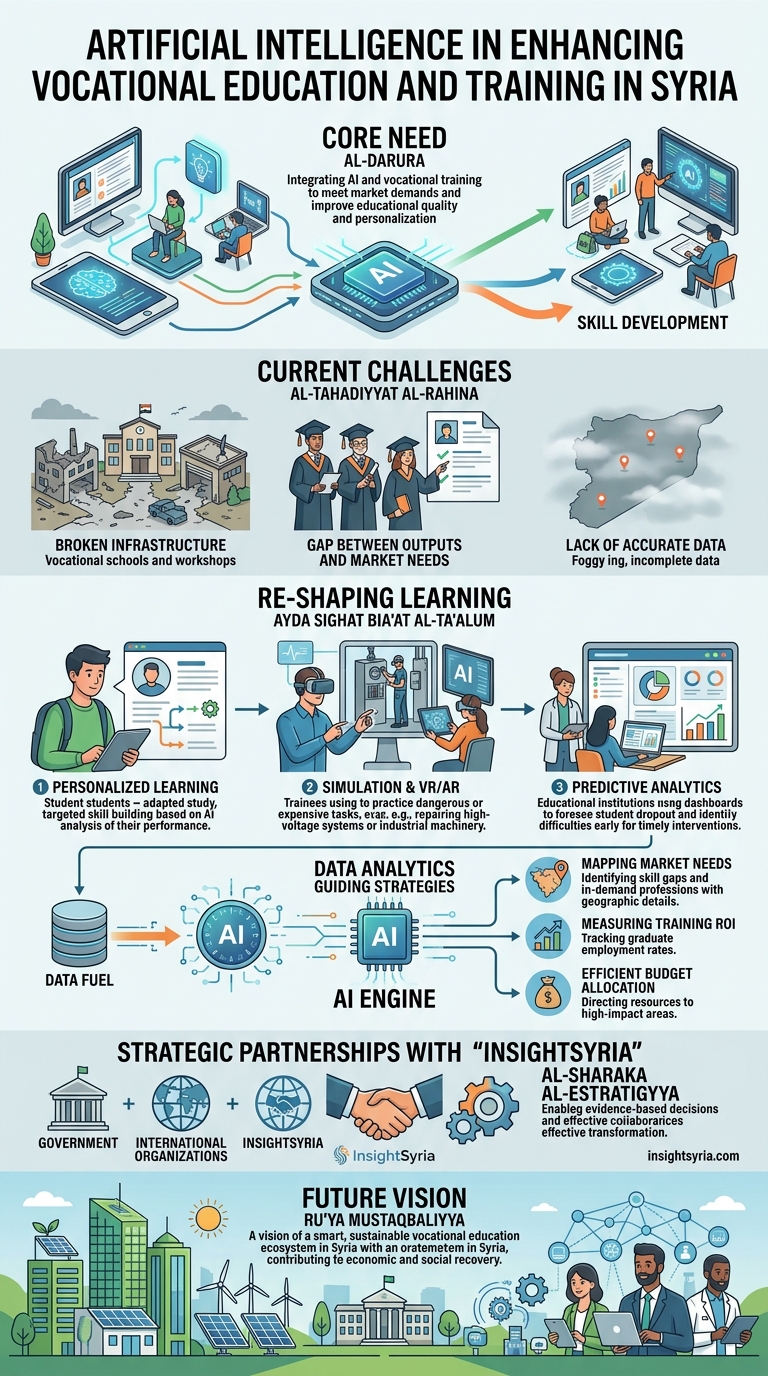
- Artificial Intelligence as a Necessity: The integration of artificial intelligence technologies and vocational training has become an urgent necessity in light of market requirements.
- Improving Education Quality: AI provides solutions to enhance educational content and offers personalized learning for each student.
- Accurate Assessment: Advanced analytics can be used to monitor student performance and better guide educational programs.
- Current Challenges: The education sector in Syria faces significant challenges that require innovative and swift solutions.
- Strategic Partnerships: Collaboration among various institutions is the path to ensuring the success of digital transformation in education.
Table of Contents
- The Role of Artificial Intelligence in Developing the Education and Vocational Training Sector in Syria: Necessity and Prospects
- Current Challenges in the Syrian Education and Vocational Training Sector
- How is Artificial Intelligence Reshaping the Vocational Learning Environment?
- The Role of Data Analytics in Guiding Vocational Training Strategies in Syria
- Strategic Partnership with “InSight Syria”: Your Gateway to Evidence-Based Decision-Making
- Future Vision: Towards a Smart and Sustainable Vocational Education System in Syria
The Role of Artificial Intelligence in Developing the Education and Vocational Training Sector in Syria: Necessity and Prospects
The topic of The Role of Artificial Intelligence in Developing the Education and Vocational Training Sector in Syria is a central focus for strategic discussions among educational institutions and decision-makers. Given the extraordinary circumstances that the education sector in Syria has faced in recent years, there is an urgent need to find innovative and effective solutions to overcome obstacles related to traditional infrastructure deficiencies and to provide high-quality education that reaches all age groups, particularly young people and those seeking opportunities for professional retraining.
Artificial intelligence is not just intelligent software tools; it is a comprehensive system capable of simulating human thinking, continuous learning, and self-development. When this technology is applied to the education and vocational training sector in Syria, it provides radical solutions to historical problems, such as centralized education, rigidity in curricula, lack of accurate assessment mechanisms, and difficulty in measuring return on investment in training programs. By applying AI algorithms, the educational process can be transformed from a rigid traditional path into a dynamic interactive environment that adapts to the individual needs of each trainee or student.
Current Challenges in the Syrian Education and Vocational Training Sector
Before delving into the details of technological solutions, it is essential to have an objective reading of the current reality based on available indicators and data. The education and vocational training sector in Syria faces a series of structural and logistical challenges, including:
- The Gap Between Outputs and Labor Market Needs: Many traditional curricula lack the necessary flexibility to keep up with the rapid developments in modern professions, resulting in graduates who lack direct practical skills.
- Scarcity of Resources and Damaged Infrastructure: Many vocational institutes and technical schools have suffered varying degrees of damage, making the expansion of traditional workshops a costly and slow endeavor.
- Lack of Accurate Data for Planning: Institutions often lack comprehensive and updated databases on labor market trends, unemployment rates by specialties, and the most in-demand skills across various Syrian governorates.
Here, the central role of “InSight Syria” emerges; we work to bridge this gap by providing accurate research and analytical services that combine field data collection and the use of advanced analytical techniques to reach reliable conclusions that assist decision makers and organizations in directing their resources towards optimal investment in human capital.
How is Artificial Intelligence Reshaping the Vocational Learning Environment?
The practical applications of artificial intelligence in the vocational training and education sector are numerous and can be classified into several main axes that directly contribute to enhancing efficiency and effectiveness:
1. Personalized Learning
It is well known that trainees possess different capabilities and ways of understanding. AI systems allow for the analysis of a trainee’s performance during practical exercises or theoretical tests, and then adjust the educational content to suit the speed and learning style of each individual. In vocational training centers in Syria, this technology can help trainers focus on the trainee’s weaknesses and provide additional materials aimed at bridging skill gaps.
2. Simulation and AI-Powered Virtual Reality (VR & AR)
In fields that require costly or hazardous hands-on training (such as maintaining complex electricity networks, repairing large industrial machinery, or modern construction techniques), AI-powered virtual training provides a safe and risk-free environment for trainees. These systems analyze the trainee’s performance within the simulation environment and provide real-time feedback on accuracy, speed, and adherence to occupational safety standards.
3. Performance Data Analysis and Predictive Analytics in Education
By integrating advanced data analytics, educational and training institutions can predict student or learner dropout rates and identify potential difficulties before they escalate. These proactive insights enable administrations to intervene early and provide appropriate academic, psychological, or technical support to ensure trainees successfully complete their programs.
The Role of Data Analytics in Guiding Vocational Training Strategies in Syria
It is impossible to talk about artificial intelligence in isolation from data analytics, as the former requires the fuel that powers it, and the latter is the primary source of this fuel. At “InSight Syria,” we understand that the success of any developmental plan for the education and vocational training sector is entirely dependent on the quality and abundance of data.
Data analytics helps government organizations, donors, and NGOs to:
- Create an Accurate Map of Labor Market Needs: By collecting and analyzing job advertisements, employer surveys, and data from various economic sectors in Syria, precise identification of professions that are experiencing skills shortages can be undertaken.
- Measure Return on Investment (ROI) of Training Programs: Evaluate the success of vocational training courses in integrating graduates into the labor market, and calculate the percentage of beneficiaries who secured actual job opportunities after training.
- Effectively Direct Budgets: Assist decision-makers in allocating financial and logistical resources to the areas and sectors in greatest need, thus minimizing waste and achieving the highest possible social and economic impact.
Strategic Partnership with “InSight Syria”: Your Gateway to Evidence-Based Decision-Making
The rebuilding and development phase in Syria requires concerted efforts among all actors: government institutions, civil society organizations, international bodies, and private companies. At “InSight Syria,” we take pride in being the trusted partner that combines a deep understanding of the local environment with advanced expertise in the latest tools of scientific research, data analysis, and artificial intelligence.
Whether you are a government ministry seeking to update vocational education strategies, an international organization wishing to design a sustainable training program for Syrian youth, or a research institution aiming to conduct a comprehensive survey on the state of skills in the local market, our team of experts, data scientists, and researchers is ready to provide customized solutions that accurately and professionally meet your needs. We believe that accurate data is the cornerstone of every successful policy, and that artificial intelligence technology is the key to unlocking the latent potential of Syrian youth.
Future Vision: Towards a Smart and Sustainable Vocational Education System in Syria
Integrating artificial intelligence and data analytics in the education and vocational training sector in Syria is not just a technological luxury but a strategic imperative for achieving economic and social recovery. This transformation requires a concerted effort to build an appropriate digital infrastructure, train teaching and administrative staff on the use of modern tools, and formulate flexible policies that align with global standards while respecting local privacy.
In conclusion, “InSight Syria” reaffirms its solid commitment to supporting the development process in the country by providing the highest levels of market research services, surveys, and data analysis. We invite all institutions and parties concerned with vocational and educational development to contact us to explore how our expertise and innovative solutions can contribute to creating a brighter and more sustainable future for the education and vocational training sector in Syria and to shape decisions based on accurate knowledge and concrete evidence.
Frequently Asked Questions
What is the role of artificial intelligence in education?
Artificial intelligence enhances the learning experience by providing personalized content and tools to assess student performance.
How can curricula be improved using data?
Data analytics can be used to identify skill gaps needed in the labor market and update educational curricula accordingly.
What are the main challenges facing education in Syria?
Challenges include lack of infrastructure, absence of accurate data, and the gap between education and labor market needs.