
Not Just Questions and Answers: How Do Drag and Drop Exercises Create an Interactive Experience That Reveals What Participants Truly Prefer?
- Drag and drop exercises provide accurate data on participants’ preferences.
- They help break the monotony associated with traditional surveys.
- They enable better understanding of consumer behavior beyond social biases.
- They offer interactive platforms that make data collection an enjoyable experience.
- They assist governments and organizations in making data-driven decisions.
Table of Contents
- Why Do Traditional Surveys Sometimes Fail to Accurately Reflect Reality?
- What Are Drag and Drop Exercises in Market Research and Surveys?
- How Do Drag and Drop Exercises Reveal What Participants Truly Prefer?
- Practical Applications of Drag and Drop Questions in Various Sectors
- Steps to Design a Successful “Drag and Drop” Exercise: From Methodology to Analysis
- The Role of Insight Syria in Elevating Data Quality and Market Research
- In Conclusion
Why Do Traditional Surveys Sometimes Fail to Accurately Reflect Reality?
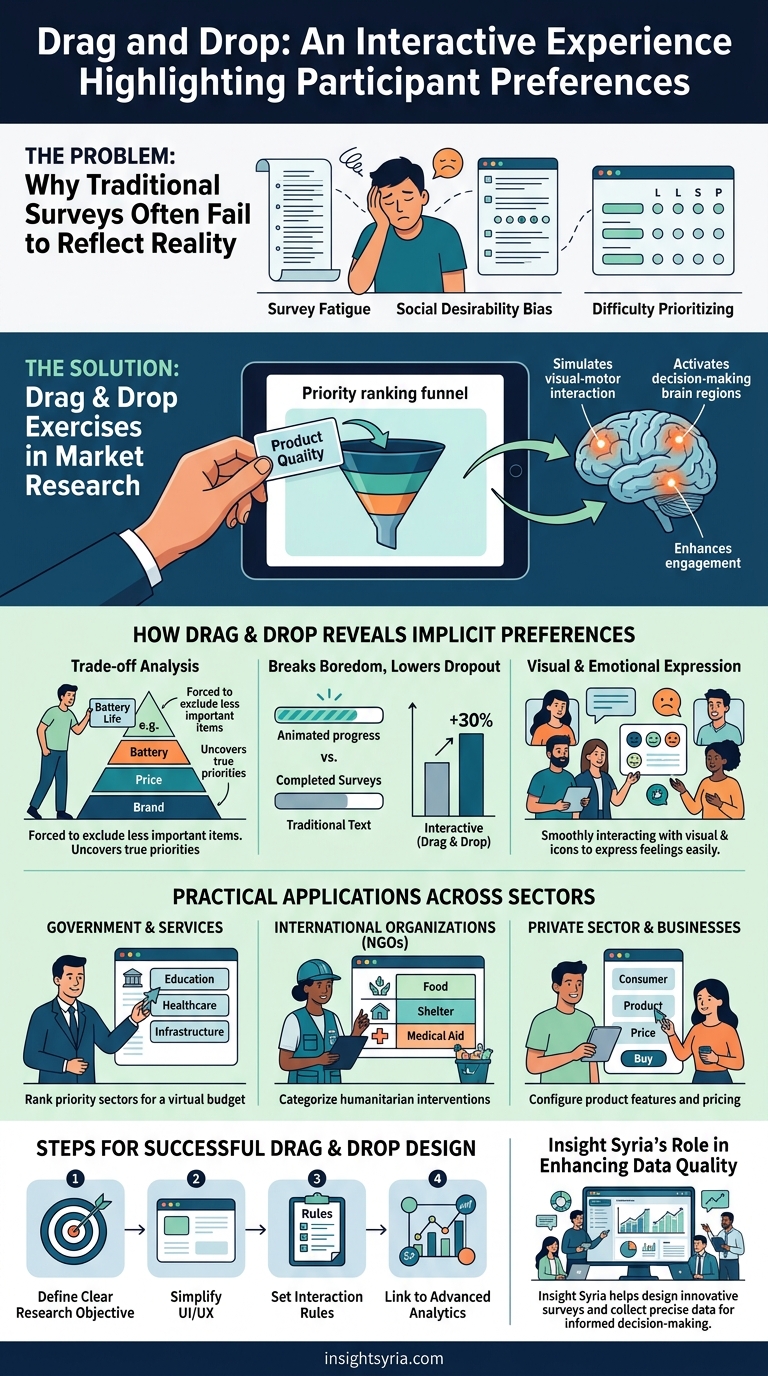
Before diving into “drag and drop” techniques, it is essential to address the classic challenges that market research and public opinion surveys face. Traditional surveys often rely on Likert scales or yes/no questions. Despite the simplicity of these tools, they suffer from significant structural flaws, including:
- Survey Fatigue: When a participant faces a long series of similar text questions, they gradually lose focus.
- Social Desirability Bias: Participants tend to provide only socially acceptable answers.
- Difficulty in Prioritization: Traditional tools fail to reveal true preferences.
What Are Drag and Drop Exercises in Market Research and Surveys?
The drag and drop technique in research designs relies on simulating visual kinetic interaction. Participants are asked to drag items and drop them in designated spaces, such as prioritizing them or allocating a virtual budget.
When a participant’s hand moves to move an item, multiple brain areas associated with decision-making are activated, increasing participant engagement and enhancing interaction.
How Do Drag and Drop Exercises Reveal What Participants Truly Prefer?
The secret behind the success of these exercises lies in their ability to measure implicit behavior. Here’s how these tools achieve superior results:
1. Real Trade-off Analysis
Example: If you ask a participant about the importance of certain features in a consumer product, when asked to drag and drop 5 features within a limited space pyramid, they will have to eliminate what is less important, revealing their true preference.
2. Breaking Boredom and Reducing Drop-out Rates
Statistics indicate that completion rates for interactive surveys increase by over 30%.
3. Analyzing Visual and Emotional Content
This approach allows for expressing feelings and societal trends from diverse social segments smoothly and clearly.
Practical Applications of Drag and Drop Questions in Various Sectors
Firstly: Government and Service Sector
Government ministries seek to measure citizens’ satisfaction. Practical Application: Designing a drag and drop exercise to prioritize vital sectors within a virtual government budget.
Secondly: International and Non-Governmental Organizations (NGOs)
Humanitarian organizations work to assess community needs. Practical Application: Using a drag and drop matrix to classify types of humanitarian interventions.
Thirdly: Commercial Companies and Private Sector
Companies need to understand consumer behavior. Practical Application: A drag and drop exercise for pricing structure and product specifications.
Steps to Design a Successful “Drag and Drop” Exercise: From Methodology to Analysis
- Clearly Define Research Objective: The question must be designed to serve this goal exclusively.
- Simplify the User Interface (UI/UX): The tool must be easy to use and smooth.
- Set Interaction Boundaries: Clearly define the rules to provide an effective user experience.
- Link with Advanced Analytical Engines: The platform should record the final outcome and the decision-making process.
The Role of Insight Syria in Elevating Data Quality and Market Research
At Insight Syria, we assist institutions in designing innovative surveys and gathering accurate data, supporting informed decision-making.
In Conclusion
Using interactive tools like drag and drop exercises has become a necessity for every researcher and decision-maker. With these tools, you can more accurately uncover community preferences and market trends.
If you represent a government entity, international organization, or company and want to collect reliable data, the Insight Syria team is here to help you achieve that.
Frequently Asked Questions
How Can I Use Drag and Drop Exercises in My Surveys?
You can design surveys that include drag and drop elements to facilitate the evaluation process.
What Are the Main Benefits of Using This Technique?
They help increase participation rates and provide accurate answers that reflect true preferences.
How Can Drag and Drop Exercises Improve Data Quality?
By increasing participant engagement, leading to more truthful and reliable data.