Strategy and Leadership: A Comprehensive Guide to Analyzing Sales Representatives’ Performance and Linking Incentives to Efficiency and Productivity Indicators in the Syrian Market
- Analyzing sales representatives’ performance is essential for achieving success in the Syrian market.
- The importance of linking incentives to efficiency and productivity indicators to improve team performance.
- The challenges organizations face in the Syrian economic environment and how to overcome them.
- Practical steps to build an incentive system linked to performance indicators (KPIs).
- The role of Insight Syria in providing support to institutions and government entities.
Table of Contents
- Strategy and Leadership: Why do Syrian organizations need to shift to data-driven management?
- Analysis of Sales Representatives’ Performance and Linking Incentives to Efficiency and Productivity: Basic Concepts
- Challenges of the Syrian Market and How to Utilize Data to Overcome Them
- Practical Steps to Build an Incentive System Linked to Performance Indicators (KPIs)
- Role of Insight Syria in Supporting Institutions and Government Entities
- Conclusion: Towards a Sustainable Leadership Future
Strategy and Leadership: Why do Syrian organizations need to shift to data-driven management?
Strategic leadership is currently the compass that guides organizations towards achieving their long-term goals. In the sales sector, the sales representative is the frontline of the organization and the link between it and customers, whether they are end consumers (B2C) or other companies and institutions (B2B).
Therefore, adopting an effective strategy and leadership begins with answering the fundamental question: How do we measure what a sales representative has really accomplished? Is it merely the total sales volume, or are there other dimensions concerning the efficiency of resource use, time, customer satisfaction, and the quality of revenue collection?
In the Syrian market, where purchasing power and price fluctuations are influenced by complex economic factors, relying on traditional methods for evaluating sales (such as providing incentives based solely on raw sales figures) is a strategic mistake that could lead to:
- Frustration among diligent employees working in difficult sectors or regions.
- A focus on sales that may not be profitable for the organization in the long run.
- Neglecting key performance indicators (KPIs) that measure quality, efficiency, and professionalism.
Hence, there emerges an urgent need to apply a precise scientific methodology based on analyzing sales representatives’ performance and linking incentives to efficiency and productivity indicators.
Analysis of Sales Representatives’ Performance and Linking Incentives to Efficiency and Productivity: Basic Concepts
For senior management and sales managers to build a fair and effective system, they must first deconstruct the term “performance” into measurable and analyzable components. The process of analyzing sales representatives’ performance and linking incentives to efficiency and productivity simply means shifting from evaluating “the final result” alone to evaluating “the journey, effort, and efficiency” that led to that result.
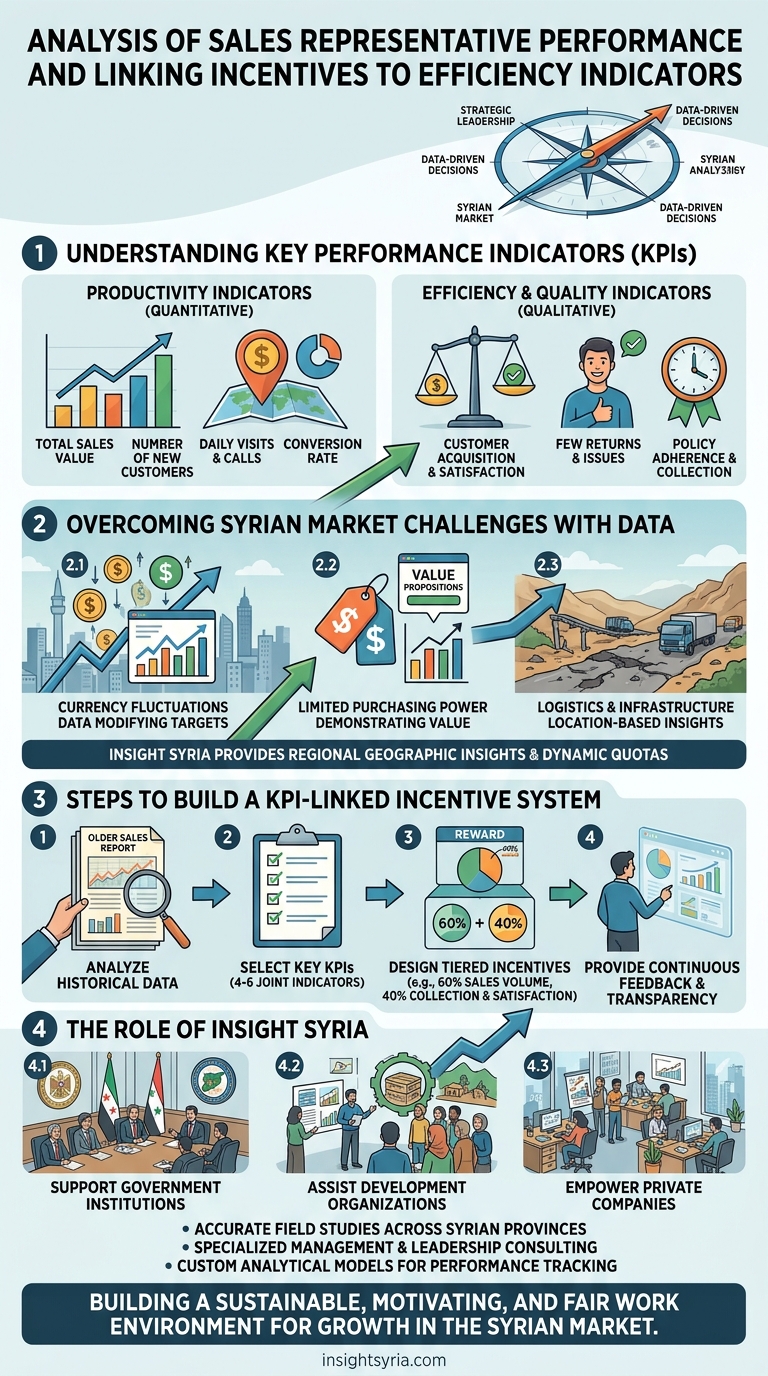
1. Performance Indicators Related to Productivity (Quantitative KPIs)
These indicators measure quantity and volume and include, but are not limited to:
- Total value of sales achieved versus the target (Quota).
- Number of new customers acquired during the specified time period.
- Number of customer field visits or daily calls (Activity Indicator).
- Conversion rate of potential customers to actual customers.
2. Performance Indicators Related to Efficiency and Quality (Qualitative KPIs)
Productivity alone is not sufficient if accompanied by high costs or low customer satisfaction. Thus, efficiency focuses on how those results are achieved and includes:
- Customer acquisition cost (CAC).
- Customer retention and satisfaction rate.
- Return or post-sale issue rate.
- Compliance with timelines and the organization’s credit policies (such as cash collection ratios and debt follow-up).
By integrating these indicators together, management obtains a comprehensive and objective picture that allows them to evaluate each sales representative based on their actual environment and surrounding circumstances in the Syrian market.
Challenges of the Syrian Market and How to Utilize Data to Overcome Them
It is impossible to discuss sales and analyze them in Syria without acknowledging the real challenges faced by companies, such as:
- Continuous fluctuations in exchange rates: which sometimes makes it difficult to adopt fixed sales plans throughout the year.
- Limited purchasing power: requiring high efficiency in convincing the customer of the added value of the product or service.
- Infrastructure and logistics challenges: such as difficulties in moving between provinces at times or interruptions in communications and electricity, affecting the flow of communication with customers.
At “Insight Syria”, we assist companies and organizations in deeply understanding these variables. Through our advanced services in data collection and analysis, we can help management adjust dynamic targets (Dynamic Quotas) to fit the economic realities of each geographic area in Syria, ensuring that the process of analyzing sales representatives’ performance and linking incentives to efficiency and productivity indicators remains fair and motivating rather than a source of frustration.
Practical Steps to Build an Incentive System Linked to Performance Indicators (KPIs)
To reap the benefits of the new incentive system, it must be designed and implemented following carefully considered and analytically sound steps. Here is a proposed roadmap:
Step One: Audit and Analyze Historical Data
Before establishing any new indicators, it’s essential to review historical sales data from previous years or months. What are the seasons when sales increase? What are the most active areas? What are the characteristics of the most successful sales representatives? This exploratory analysis provides a realistic starting point.
Step Two: Accurately Define Key Performance Indicators
Sales representatives should not drown in dozens of complex indicators. It is better to choose 4 to 6 core indicators that mix quantity (sales volume) and quality (service and collection quality), which are clear, measurable, and fully understood by the employee.
Step Three: Design a Tiered Incentive Structure
Instead of an “all or nothing” system (where the employee receives an incentive only if achieving 100% of the target), it is preferable to adopt a tiered structure that rewards the employee for every achievement they accomplish above a reasonable minimum. Additionally, incentives should include relative weights; for example, sales volume may represent 60% of the incentive, while commitment to collecting debts represents the remaining 40% satisfaction.
Step Four: Ongoing Transparency and Feedback Loops
Sales representatives should always be aware of their current status compared to the targets. Providing digital dashboards or clear periodic reports builds deep trust between management and the team and fosters a positive competitive spirit.
Role of Insight Syria in Supporting Institutions and Government Entities
Managing human resources and making strategic decisions today require advanced research tools. Our work at “Insight Syria” does not stop at providing dry numbers; instead, we translate data into actionable insights.
Whether you represent a government entity seeking to enhance the performance of its affiliated service and economic institutions, an international or local organization working in developmental issues, or a private company aiming for greater market share dominance, our team of experts in market research, surveys, and data analysis offers you:
- Accurate Field Studies: measuring market trends and consumer behavior in various Syrian provinces.
- Specialized Management and Leadership Consultations: to assist executive management in reorganizing sales departments and developing incentive policies.
- Building Customized Analytical Models: that align with your organization’s nature of work and help you track performance moment by moment.
Conclusion: Towards a Sustainable Leadership Future
In conclusion, it is clear that focusing on effective strategy and leadership is no longer an administrative luxury but a necessity for success and continuity. Implementing a studied scientific methodology in analyzing sales representatives’ performance and linking incentives to efficiency and productivity indicators ensures the creation of a stimulating work environment, built on justice and transparency, driving the company towards new horizons of growth.
At Insight Syria, we bring our advanced expertise and research capabilities to assist you in making the right decisions and building evidence-based strategies within the Syrian market. Let’s work together to transform your data into real value and a driving force for your institution towards the top. Contact us today to discover how our research and analytical services can make a real difference in your organization’s journey.