
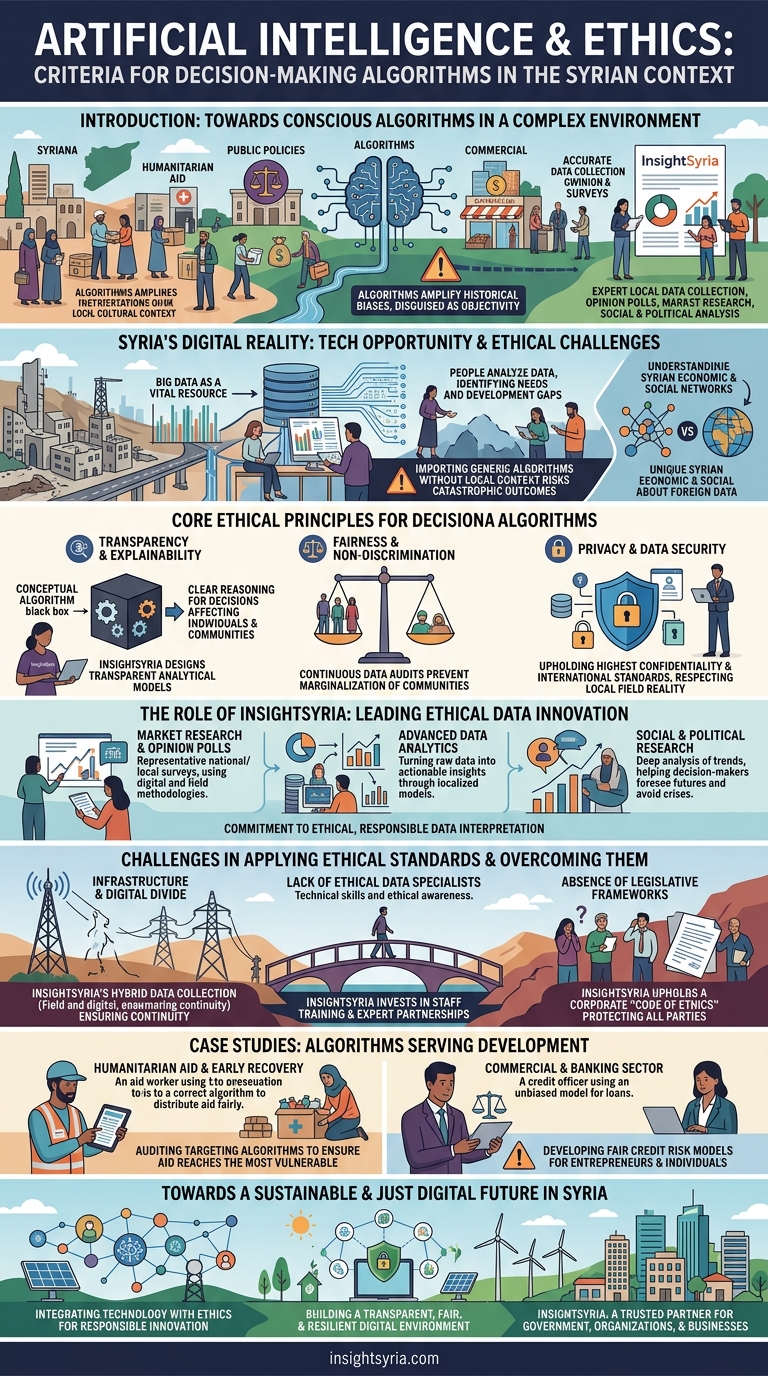
Artificial Intelligence and Ethics: Standards for Using Decision-Making Algorithms in the Syrian Context
- Highlighting the importance of integrating artificial intelligence and ethics in Syria.
- The necessity of establishing national standards for the use of decision-making algorithms to ensure individual rights.
- Presenting the ethical principles that institutions must adhere to when applying artificial intelligence technologies.
- The challenges that may arise in applying ethical standards and how to overcome them.
- The importance of the role of “Enset Syria” in guiding ethical innovation in the field.
Table of Contents
- Introduction: Towards a Conscious Understanding of Algorithms in a Complex Environment
- Digital Realities in Syria: A Technological Opportunity and Ethical Challenges
- Core Ethical Principles for Decision-Making Algorithms
- The Role of “Enset Syria” in Leading Ethical Data Innovation
- Challenges of Applying Ethical Standards in Syria and How to Overcome Them
- Case Studies and Practical Examples: Algorithms in Service of Development
- Towards a Sustainable and Fair Digital Future in Syria
- Conclusion
Introduction: Towards a Conscious Understanding of Algorithms in a Complex Environment
When we talk about Artificial Intelligence and Ethics: Standards for Using Decision-Making Algorithms in the Syrian Context, we are not discussing a purely theoretical concept, but dealing with tools that directly affect the lives of citizens, the distribution of humanitarian aid, the shaping of public policies, and the directing of commercial investments. In recent years, data has shown that reliance on algorithms for decision-making is steadily growing, whether in the communications sector, banking, or in the developmental assessments led by NGOs.
However, are these algorithms truly neutral? The scientific and practical answer is: not necessarily. Algorithms are built on historical data, and if this data carries certain biases or reflects extraordinary periods of crises, then the algorithm will reproduce those biases, albeit under a digital cover that seems objective and infallible. Hence, the importance of the role of a specialized company like “Enset Syria” comes into play, where we have deep expertise in data collection, conducting opinion polls, market research, and social and political analyses with utmost precision that takes into account the local and cultural context of Syria.
Digital Realities in Syria: A Technological Opportunity and Ethical Challenges
The economy and society in Syria are undergoing a delicate reshaping phase. Amid these transformations, big data has become a vital resource. Data analytics and artificial intelligence play a central role in helping decision-makers understand the pressing needs of the population, identify developmental gaps, and direct available resources efficiently.
Nevertheless, importing or applying ready-made algorithms developed in Western or entirely different environments from the Syrian reality can lead to disastrous results. The Syrian environment is characterized by economic and social particularities that require a deep understanding of local relational networks, household consumption patterns, and the structural challenges imposed by years of crisis.
Therefore, integrating Artificial Intelligence and Ethics: Standards for Using Decision-Making Algorithms in the Syrian Context is not just an optimization option, but an existential necessity for institutions seeking to provide responsible and sustainable services. This process requires setting clear regulations that ensure transparency, accountability, and the prevention of digital discrimination.
Core Ethical Principles for Decision-Making Algorithms
To build a fair and trustworthy artificial intelligence system in Syria, it is essential to rely on a set of global ethical principles and adapt them locally:
1. Transparency and Explainability
Advanced artificial intelligence models are often described as “black boxes,” where inputs and outputs are known, but the internal decision-making mechanism remains obscure even to the developers themselves. In the context of decision-making – especially those related to public policies or aid distribution – algorithms must be capable of providing a clear and comprehensible explanation of why a particular decision was made regarding an individual or local community. At “Enset Syria,” we always ensure to design analytical models that exhibit absolute transparency, which allows officials to understand the foundations upon which recommendations are built.
2. Fairness and Non-discrimination
Algorithmic bias is one of the most prominent ethical risks. If an artificial intelligence system is trained on data collected from specific urban areas in Syria, it may fail to accurately understand the needs of rural or bedouin areas, leading to the marginalization of large segments of society. The standards for using decision-making algorithms require continuous review of training data to ensure fair representation of all segments of Syrian society without exception.
3. Privacy and Data Security
As reliance on digital solutions increases, protecting citizens’ personal data is the first line of defense against violations. Any organization or governmental entity that uses decision-making algorithms must adhere to the highest standards of confidentiality and cybersecurity. We at “Enset Syria” prioritize the protection of individuals’ privacy, applying strict data collection protocols that align with international standards while fully respecting local legislation and the field realities.
The Role of “Enset Syria” in Leading Ethical Data Innovation
As a leading company based in the heart of the Syrian landscape, we fully understand the significant gap between the technical tools available and the ability to employ them ethically and effectively. We offer a comprehensive package of services that enables government institutions, large corporations, and international organizations to make evidence-based and secure decisions.
Our expertise at “Enset Syria” spans multiple areas that integrate to form a comprehensive picture of the Syrian landscape:
- Market Research and Opinion Polls: We design and implement nationally and locally representative opinion polls, using the latest methodologies for digital and field sampling, ensuring we obtain accurate insights reflecting the pulse of the Syrian street.
- Advanced Data Analytics: We help our partners transform raw data into actionable insights through statistical models and tailored algorithms that accurately account for the local context.
- Social and Political Research: We provide in-depth analyses of societal and political trends, aiding decision-makers in anticipating the future and avoiding potential crises.
Our commitment to the subject of Artificial Intelligence and Ethics: Standards for Using Decision-Making Algorithms in the Syrian Context stems from our professional and ethical responsibility to the community we serve. We do not just provide numbers; we help our clients interpret them wisely and responsibly.
Challenges of Applying Ethical Standards in Syria and How to Overcome Them
Discussing strict ethical standards for artificial intelligence in Syria encounters some real challenges that must be acknowledged and dealt with flexibly and realistically:
1. Infrastructure and Digital Divide
The telecommunications and technology infrastructure in Syria faces severe challenges, from power shortages to slow internet speeds in some areas. This reality complicates the continuous collection and analysis of data through the digital cloud. To overcome this, “Enset Syria” has developed hybrid methodologies that combine traditional field data collection with advanced digital analysis, ensuring the continuity and accuracy of operations regardless of technical obstacles.
2. Shortage of Specialized Personnel in Digital Ethics
There is a relative shortage of specialists who combine technical knowledge in data science with philosophical and ethical awareness of its applications. “Enset Syria” continuously invests in developing its human resources and building partnerships with local and global experts to ensure the highest standards are applied in every project we undertake.
3. Absence of Regulatory Legislative Frameworks
Like many countries in the region, legal regulations concerning artificial intelligence and data protection in Syria are still in their early stages or need radical updates to keep pace with accelerating technological development. In the absence of such legislative frameworks, professional companies like “Enset Syria” play a pioneering role in imposing an “institutional code of ethics” that obligates those working in the data analysis sector to adhere to stringent ethical standards that protect beneficiaries and decision-makers alike.
Case Studies and Practical Examples: Algorithms in Service of Development
To illustrate how Artificial Intelligence and Ethics: Standards for Using Decision-Making Algorithms in the Syrian Context intersect in reality, we can look at several vital areas:
Humanitarian Aid and Early Recovery Sector
International and local organizations rely on targeting algorithms for aid distribution. If these algorithms are not designed with precise ethical standards that consider the “Do No Harm” principle, they may result in the exclusion of deserving families due to data errors or biases in the models. Through the research and evaluation services provided by “Enset Syria”, we help these organizations audit their models and correct the trajectory of algorithms to ensure that support reaches its rightful beneficiaries transparently and fairly.
Commercial and Banking Sector
Banks and commercial companies in Syria seek to adopt credit risk assessment technologies through artificial intelligence. Here, the importance of setting standards to prevent discrimination against certain groups of entrepreneurs or individuals becomes evident. “Enset Syria” provides advanced consultancy to companies that help them build fair and reliable predictive models that protect corporate interests and enhance trust with clients.
Towards a Sustainable and Fair Digital Future in Syria
The journey towards building a prosperous digital future in Syria fundamentally hinges on our ability to integrate technology with ethics. Technological innovation cannot be separated from social responsibility. When we talk about Artificial Intelligence and Ethics: Standards for Using Decision-Making Algorithms in the Syrian Context, we are outlining a roadmap for a future where technology serves humanity, rather than enslaving it, and where data supports sustainable development instead of becoming an additional burden on society.
At “Enset Syria”, we are proud to be a trusted partner for government entities, organizations, and companies seeking quality, professionalism, and scientific integrity. Our extensive experience in data analytics and artificial intelligence, along with our deep understanding of the Syrian social and political fabric, makes us the ideal choice for anyone looking to make informed, evidence-based decisions.
We invite all institutions and those interested in public affairs in Syria to adopt a conscious and ethical approach to using decision-making algorithms and invest in the quality of data and its analysis. Let us work together to build a transparent, fair digital environment capable of facing future challenges with confidence and competence.
Conclusion
In conclusion, the topic of Artificial Intelligence and Ethics: Standards for Using Decision-Making Algorithms in the Syrian Context remains the cornerstone of any sustainable technological development process in the country. The significant challenges faced by institutions should not be an obstacle to adopting the latest technologies in data analytics and artificial intelligence, but rather serve as an additional impetus to establish stringent ethical standards that ensure justice, transparency, and accountability.
“Enset Syria” places all its capabilities and deep expertise in the fields of market research, opinion polls, and data analysis at your service. We are here to help you navigate the complexities of the digital age and turn complex data into smart and ethical decisions that serve the community and drive development forward. Contact us today to find out how our specialized services can meet your institution’s needs and elevate the quality of your decisions in the evolving Syrian context.