The Impact of Real-time Analytics on the Speed of Response to Humanitarian Crises: A Strategic Perspective from the Field
- Real-time analytics are a revolutionary tool in disaster and emergency management.
- Real-time data helps reduce response time and improve operational efficiency.
- Facilitates effective coordination among multiple actors in humanitarian crises.
- Real-time analytics face challenges related to data quality and privacy.
- “Insight Syria” plays a pivotal role in enhancing digital transformation in this field.
Article Contents
- Introduction: When Speed Becomes a Difference Between Life and Death
- The Concept of Real-time Analytics and How It Works in Humanitarian Contexts
- The Impact of Real-time Analytics on the Speed of Response to Humanitarian Crises
- Challenges and Ethical Considerations in Using Real-time Analytics
- The Role of “Insight Syria” in Leading Digital Transformation and Advanced Analytics
- Case Studies and Practical Examples: How Does Real-time Analytics Make a Difference?
- Building a Sustainable and Crisis-Ready Future
- Call to Action
Introduction: When Speed Becomes a Difference Between Life and Death
Humanitarian organizations and governmental bodies face unprecedented challenges when dealing with crises, whether they are natural disasters like earthquakes and floods, prolonged humanitarian crises, or health emergencies. In such circumstances, time is the most critical factor; every minute wasted in collecting traditional information or waiting for paper reports means worsening suffering and increased losses.
Here, a fundamental question arises regarding the impact of real-time analytics on the speed of response to humanitarian crises and how it can transform raw data flowing from the field into actionable insights. The shift from “retrospective analysis” (which looks at what happened in the past) to “real-time analysis” (which reads what is happening now and predicts what will happen in the coming moments) represents a qualitative leap in the architecture of humanitarian response and resource management.
The Concept of Real-time Analytics and How It Works in Humanitarian Contexts
To understand how this technology effectively contributes, one must first clarify what is meant by real-time analytics. It is the process of processing and analyzing data as soon as it arrives or is generated, without any significant time delay. In humanitarian environments, this data comes from multiple and diverse sources:
- IoT Sensor Data: Such as devices monitoring water levels in rivers, earthquakes, or temperatures.
- Social Media Platforms: Which are filled with distress calls and eyewitness reports.
- Digital Maps and Global Positioning System (GPS): Which track displacement movements and distribution of relief teams.
- Rapid Surveys and Field Data Collection Models: Sent via smartphones by field researchers.
AI and machine learning algorithms sort, combine, and analyze this sprawling data in seconds, displaying it on interactive dashboards in front of decision-makers, allowing them to have an immediate and comprehensive view of the field situation.
The Impact of Real-time Analytics on the Speed of Response to Humanitarian Crises
Integrating real-time analytics into humanitarian and governmental workflows does not merely accelerate procedures, it redefines the efficiency of entire operations. Here are the key aspects that are positively impacted by this technology:
1. Reduction in Response Time
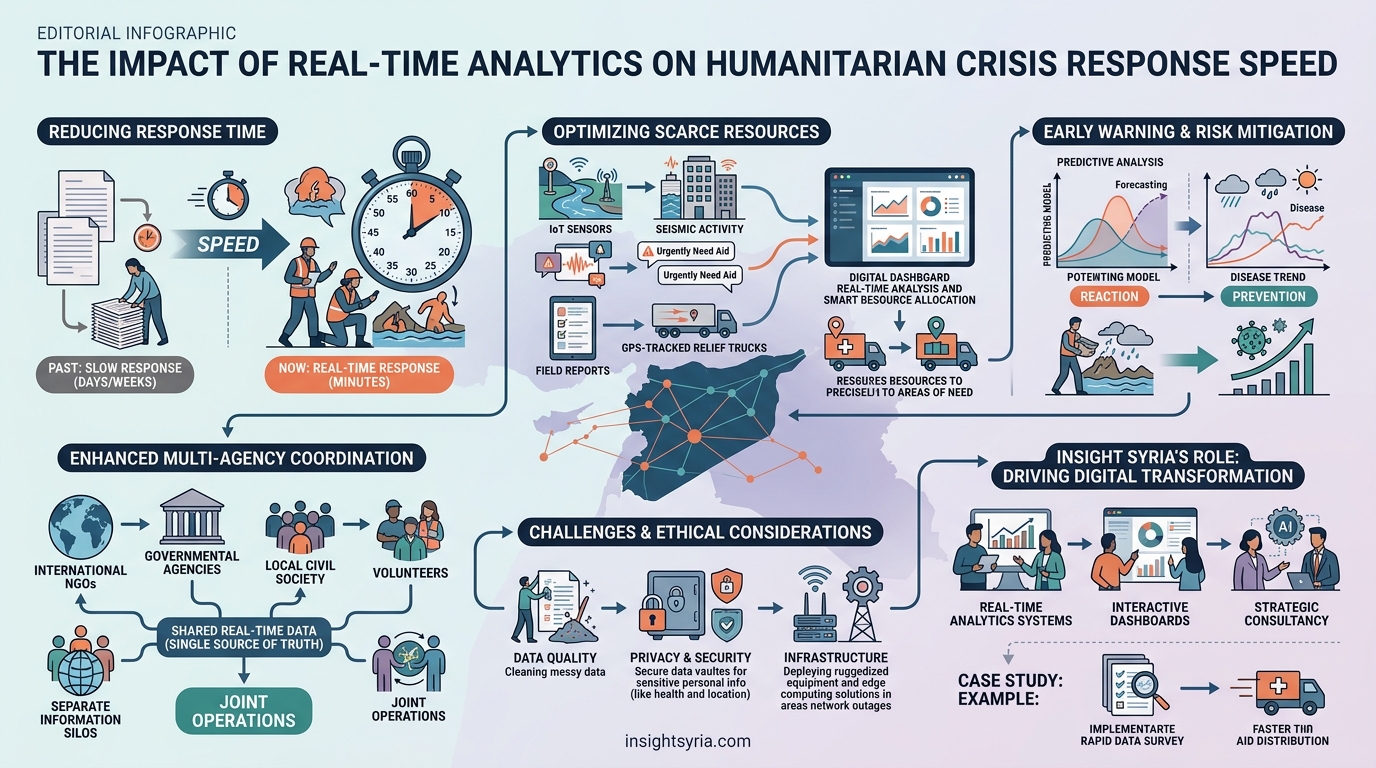
In traditional methods, data passes through a long series of bureaucracy: collecting data, entering it, cleaning it, analyzing it through lengthy paper or electronic reports, and then forwarding it to the responsible parties. This process can take days or even weeks. However, by using real-time analytics, the time from when an event occurs to when a relief team is dispatched decreases from hours and days to just a few minutes. This astonishing time reduction is critical for saving lives and providing medical and food supplies before they run out.
2. Precise and Optimal Allocation of Limited Resources
Humanitarian and governmental organizations often struggle with limited resources (budgets, medical teams, ambulances, tents, and relief supplies). Real-time analytics enable managers to know the actual needs of each area with extreme precision, rather than relying on haphazard or random estimates.
Practical Example: If real-time analytics show a severe shortage of certain medicines in a specific geographic sector due to a massive inflow of injured individuals, incoming shipments are immediately directed to that sector, bypassing previous routine plans.
3. Early Warning and Mitigation
Real-time analytics do not merely monitor the current crisis, but also extend to predict its future trajectory. By integrating historical data with current data streams, AI models can forecast the most vulnerable areas to deteriorating conditions, such as predicting the path of a flood or the outbreak of a health crisis in displacement camps. This allows organizations to transition from a “delayed reaction” state to a “proactive and preventive” stage.
4. Effective Coordination Among Multiple Actors
In any major crisis, multiple responders are involved: international organizations, governmental agencies, local associations, and volunteer teams. These organizations often suffer from information silos. Real-time analytics platforms provide a centralized, continuously updated platform (Single Source of Truth), ensuring that everyone works based on the same updated data, preventing duplication of efforts or neglect of some areas.
Challenges and Ethical Considerations in Using Real-time Analytics
Despite the immense benefits, implementing real-time analytics in humanitarian, political, and social contexts faces challenges that must be dealt with very carefully:
- Data Quality: Incorrect real-time data can lead to catastrophic decisions more quickly. Therefore, establishing accurate verification mechanisms is crucial.
- Privacy & Security: Humanitarian crises deal with extremely sensitive information about individuals (like displaced persons’ data, health cases, geographical locations). The highest standards of cybersecurity and ethical practices must be adhered to prevent any misuse of this data.
- Infrastructure and Connectivity: Often, communication and internet networks are disrupted during crises and disasters, requiring flexible solutions like using edge computing to collect and analyze data locally before transmitting it when connectivity is available.
The Role of “Insight Syria” in Leading Digital Transformation and Advanced Analytics
From our deep and specialized experience in the Syrian market and complex regional environments, “Insight Syria” recognizes that data is not just numbers; it is human stories, political decisions, and clear social and economic indicators.
As leaders in providing market research, surveys, and advanced data analytics services, we put our technical and field experiences at your service. We do not limit ourselves to collecting traditional data; we help governmental organizations, international bodies, and non-governmental institutions build intelligent systems for real-time and advanced analytics that ensure:
- Custom-designed Sensor and Field Data Systems that are tailored to the nature of local and regional challenges.
- Development of Interactive Dashboards that give managers and decision-makers a clear and immediate view of the state of humanitarian or social operations.
- Providing Specialized Consultancy in Artificial Intelligence and Big Data Analytics to enhance response efficiency and reduce resource wastage.
- Conducting Accurate and Reliable Social, Political, and Economic Research to support long-term strategic planning and short-term emergency interventions.
Case Studies and Practical Examples: How Does Real-time Analytics Make a Difference?
Let’s take an illustrative example from the field of humanitarian work; during a sudden wave of displacement or a natural disaster in an area, organizations collaborating with “Insight Syria” rely on rapid data collection mechanisms through mobile-based surveys or digital interaction analysis.
- Scenario One (Without Real-time Analytics): Assessment teams are sent on foot or by vehicles, reports take 72 hours to arrive, assistance is distributed unevenly, with neighboring areas being forgotten and suffering in silence.
- Scenario Two (With Real-time Analytics): Immediate assessment data flows from the field through smart applications, processed by our algorithms to classify areas according to severity and immediate shortages, results appear within two minutes on the central dashboard, and the first shipments are directed to the most needy areas within a few hours, with ongoing tracking of distribution moment by moment.
This enormous difference in efficiency and speed clearly illustrates why major organizations and governmental bodies are seeking reliable partners with the necessary skills and tools to implement these projects accurately and professionally.
Building a Sustainable and Crisis-Ready Future
Amid rapid changes, being prepared for crises is no longer an optional choice, but a necessity for the continuation and survival of communities. Adopting AI solutions and advanced data analytics, especially leveraging the impact of real-time analytics on the speed of response to humanitarian crises, represents a protective shield for organizations aiming to make a real and sustainable impact.
At “Insight Syria”, we believe that integrating deep human expertise with the latest digital analysis technologies is the key to building more resilient communities capable of facing challenges. Our team of data scientists, researchers, and strategic analysts is always ready to provide comprehensive support designed specifically to meet your operational and research needs.
Call to Action
Are you a governmental body, international organization, or humanitarian institution seeking excellence and developing your capabilities in data collection, social research, or advanced data analytics in the Syrian and regional context?
Do not let data accumulate without investment. Reach out to us today at “Insight Syria”, and discover how our specialized services in data analysis and artificial intelligence can enhance your operational efficiency, speed up your crisis responses, and ensure evidence-based decisions drawn from the field.
Contact our team of experts now, and start your journey towards digital transformation and human intelligence for faster and more impactful responses.