Japan’s Post-War Leap: The Role of Quality and Innovation in Understanding the Global Consumer
- Japan’s post-war leap is considered one of the greatest economic and developmental miracles.
- The Japanese transformation was based on high quality, continuous innovation, and a deep understanding of consumer requirements.
- The “Kaizen” philosophy is fundamental to continuous improvement and enhancing work efficiency.
- Total Quality Management served as the bridge to building global consumer trust in Japanese products.
- Research and surveys play a vital role in creating an innovative and data-driven economy.
Table of Contents
- How Did Japan Transform from a Devastated Economy to a Global Tech Power?
- Kaizen Philosophy: Continuous Improvement as a Way of Life and Work
- Total Quality Management (TQM): The Bridge to Global Consumer Trust
- Innovation and Accurately Meeting Consumer Demands: The Secret to Sustained Success
- The Role of Research and Surveys in Creating a New Economy
- Why Do Institutions and Organizations Need to Partner with “Insight Syria”?
- Lessons Learned from Japan Today and Syria Tomorrow
How Did Japan Transform from a Devastated Economy to a Global Tech Power?
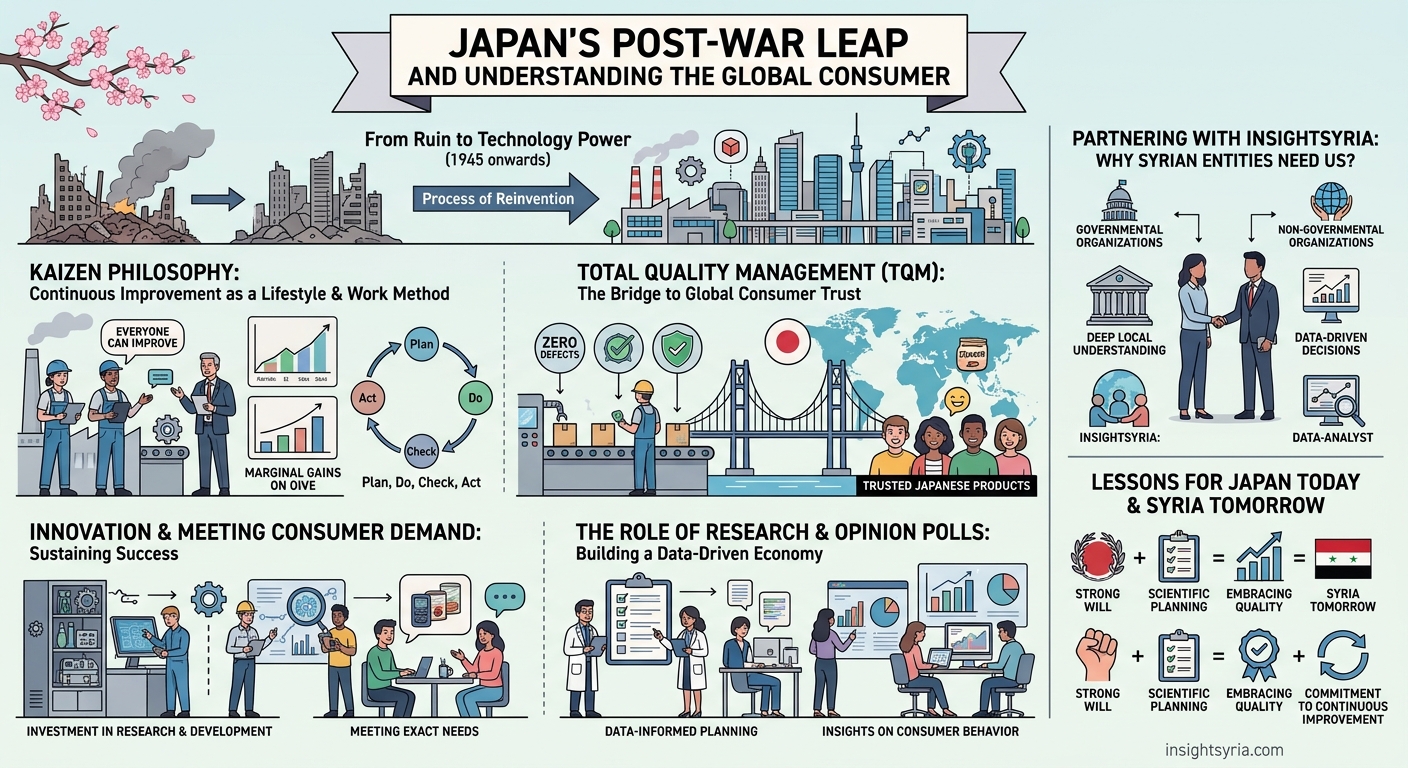
When World War II ended in 1945, Japan faced a catastrophic reality by any measure. Totally destroyed cities, rampant unemployment, hyperinflation, and a near-total lack of productive capacity. Japanese goods were known as “cheap, imitative, and of poor quality.”
However, Japanese leadership recognized early on that continuing with traditional methods would lead only to failure. This initiated a comprehensive re-engineering of the economy and industrial management thinking. Bold strategies were adopted, focusing on transforming human burdens into knowledge and skill wealth. It was not just about rebuilding factories; a new economy based on knowledge, exports, and high efficiency was created.
Kaizen Philosophy: Continuous Improvement as a Way of Life and Work
It is impossible to discuss Japan’s industrial renaissance without a prolonged focus on the concept of “Kaizen,” a word that means “continuous improvement.” Kaizen was not merely an administrative tool but evolved into a comprehensive societal culture that believes every process can be improved, even slightly.
Total Quality Management (TQM): The Bridge to Global Consumer Trust
At that stage, Japanese experts realized that achieving global competitiveness requires adopting the concept of “Total Quality Management.” This philosophy rests on the idea that quality is the responsibility of every individual in the organization, from product design to after-sales service.
Innovation and Accurately Meeting Consumer Demands: The Secret to Sustained Success
The Japanese miracle did not stop at merely imitating good practices but swiftly progressed to leadership and innovation. Japanese companies invested heavily in research and development, enabling them to innovate new technologies.
The Role of Research and Surveys in Creating a New Economy
Japan’s leap was not merely a rebuilding process but a “creation of a new economy” based on accurate information. Think tanks realized that sound planning is impossible without statistical data.
Why Do Institutions and Organizations Need to Partner with “Insight Syria”?
In light of significant challenges, improvised decisions are no longer sufficient. Government institutions need a reliable local partner with a deep understanding of the social and economic fabric.
Lessons Learned from Japan Today and Syria Tomorrow
When we reflect on Japan’s leap, we realize that sheer will is insufficient; it must be complemented by scientific planning, adopting quality, and committing to continuous improvement. These historical lessons open the door to vast economic uplift potentials in countries like Syria.
Frequently Asked Questions
What is the Kaizen Philosophy?
The Kaizen philosophy means continuous improvement and relies on the participation of all employees within the organization.
How Did Quality Contribute to the Success of Japanese Products?
Adopting Total Quality Management made Japanese products symbols of excellence and durability, strengthening consumer trust.
Why Are Research and Surveys Important in the Business Environment?
Research contributes to making decisions based on accurate data, supporting the success of various strategies.