The Green Economy in Post-Conflict: How Did Costa Rica Use Environmental Sustainability to Attract Global Investment?
- Costa Rica’s experience in the green economy is based on turning crises into opportunities through environmental sustainability.
- Success in transitioning to a green economy requires reliable data and accurate market research.
- Post-conflict countries seek to restore investment confidence through a commitment to sustainability.
- The green economy model can provide enormous potential for reconstruction in challenging contexts.
Table of Contents
- Lessons Learned from Costa Rica’s Experience: Turning Crises into Opportunities
- What is the Green Economy in the Context of Post-Conflict Recovery?
- The Role of Data and Research in Building Green Economy Strategies
- How Did Costa Rica Apply Sustainability to Attract Global Investment?
- Application of the Green Economy Model in the Regional and Syrian Context
- Challenges and Opportunities in Transitioning to a Green Economy
- The Role of “Insight Syria” as a Strategic Partner for Decision Makers
- Conclusion
Lessons Learned from Costa Rica’s Experience: Turning Crises into Opportunities
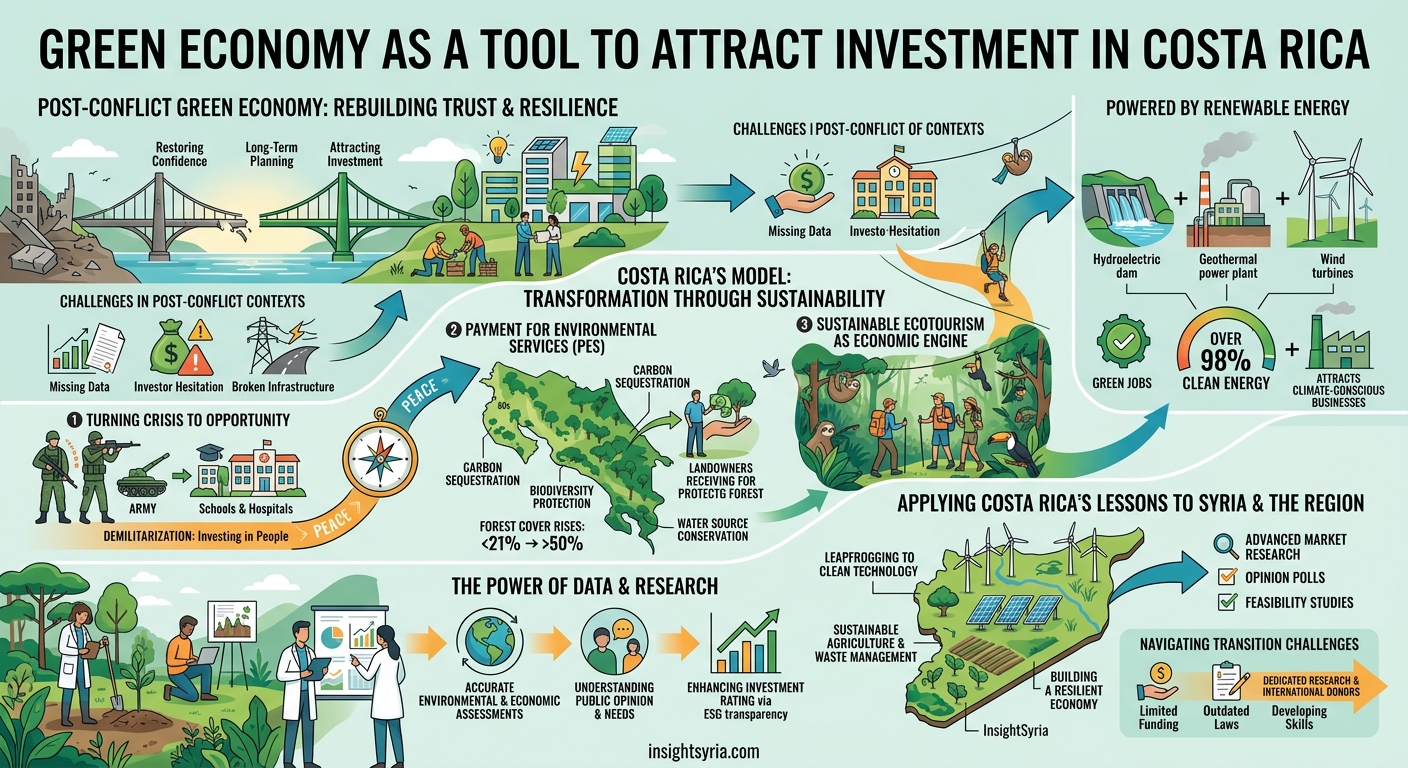
When we examine Costa Rica’s experience, we look at a country that has historically suffered from regional tensions and instability, before making radical decisions that reshaped its economic and political identity. Costa Rica not only abolished its army and redirected its budget toward education and health, but it also made the environment and sustainability a central focus of its national policies. This transformation was not an intellectual luxury but rather a purely pragmatic strategy aimed at re-attracting foreign direct investment and enhancing international trust.
The case study of Costa Rica offers exceptional lessons on how to invest and manage remaining or damaged natural resources through mechanisms that rely on accurate data and evidence-based decision-making. Here, the pivotal role of market research and data collection firms such as “Insight Syria” emerges, as the transition to a green economy requires a precise understanding of market needs, identifying promising sectors, and meticulously assessing the social and environmental impact.
What is the Green Economy in the Context of Post-Conflict Recovery?
The green economy is defined as one that results in improved human well-being and social equity, while significantly reducing environmental risks and ecological scarcity. In the post-conflict context, this concept transcends pure environmental aspects to become a flexible and efficient reconstruction mechanism.
When governments and international organizations seek recovery pathways, they face numerous challenges such as:
- Lack of reliable data: Absence of accurate figures on the extent of environmental and economic damages.
- Investor reluctance: International capital’s fear of the risks associated with post-conflict environments.
- Infrastructure decay: Traditional systems’ inability to support sustainable growth.
Therefore, applying the concept of the green economy in post-conflict: how did Costa Rica use environmental sustainability to attract global investment? presents a practical model linking resource protection to the rebuilding of trust. When a country demonstrates a genuine commitment to environmental sustainability, it sends a reassuring message to the international community and investors that it is moving towards a stable, institutionally-backed future based on long-term planning.
The Role of Data and Research in Building Green Economy Strategies
One cannot discuss a successful economic transition towards sustainability without relying on solid databases and in-depth market research. At “Insight Syria”, we fully understand that decision-making in complex environments requires more than mere forecasts; it needs rigorous scientific methodologies in data collection and analysis.
1. Comprehensive Environmental and Economic Impact Assessment
Before embarking on any green projects, a comprehensive survey of available resources and the extent of damages to the ecosystem and infrastructure must be conducted. This requires field research teams capable of collecting accurate and reliable data on the ground, taking into account local and social contexts.
2. Measuring Public Opinion and Social Trends
The success of any environmental policy related to the green economy largely depends on the acceptance of the local community. Through opinion polls and social behavior studies, governments and organizations can understand citizens’ priorities and ensure that policies are designed to serve human development alongside environmental goals.
3. Attracting Foreign Investment through Environmental Transparency
Today, international investors are seeking environmental, social, and governance (ESG) standards. Providing reliable reports based on accurate data on sustainability indicators in the country raises its investment rating and alleviates concerns related to the post-conflict phase.
How Did Costa Rica Apply Sustainability to Attract Global Investment?
To grasp the full dimensions of the green economy in post-conflict: how did Costa Rica use environmental sustainability to attract global investment?, one must dive into the actual mechanisms followed by San Jose to achieve the sustainability miracle:
A. The Payment for Environmental Services (PES) Policy
Costa Rica was one of the first countries to innovate a legal and financial system that pays landowners to preserve forests instead of cutting them down, given the invaluable services these forests offer in air purification, carbon storage, protecting water sources, and supporting eco-tourism. This system has proven highly effective in reforestation and increasing green coverage from less than 21% in the 1980s to over 50% in recent decades.
B. Eco-Tourism as an Economic Driver
Costa Rica smartly invested in its immense biodiversity and turned it into a high-value political and economic product. Instead of traditional tourism that devastates the environment, it developed the model of “sustainable eco-tourism” that attracted millions of high-spending tourists, providing thousands of job opportunities for youth and supporting local communities.
C. Transitioning to Renewable Energy at Over 98%
Costa Rica recognized that energy security is fundamental to attracting industrial and technological investment. By thoughtfully investing in hydropower, geothermal energy, and wind power, the country has become almost entirely reliant on clean energy sources, making it a preferred destination for global companies seeking to reduce their carbon footprint.
Application of the Green Economy Model in the Regional and Syrian Context
When applying these lessons to our reality in Syria and the region, it becomes evident that there is immense potential despite the harsh conditions and challenges imposed by years of conflict. Reconstruction should not mean reverting to resource-exhausting old economic models but should be a leap towards a resilient and sustainable economy.
Here, the strategic role of “Insight Syria” emerges as a reliable partner for government institutions, international organizations, and private sector companies seeking to study the Syrian market and the region. We offer a comprehensive package of services that includes:
- Advanced Market Research: Analyzing promising economic sectors in the recovery phase, such as renewable energy, sustainable agriculture, and waste management.
- Public Opinion Polls: Measuring street and corporate trends regarding new economic and environmental policies.
- Feasibility Studies and Data Analysis: Providing evidence-based insights to help investors and decision-makers minimize risks and maximize investment returns.
Governments and organizations that take the initiative today to invest in scientific research and data collection related to the green economy will lead the recovery phase and attract international capital in the near future.
Challenges and Opportunities in Transitioning to a Green Economy
Transitioning to a green economy in post-conflict environments is not a bed of roses; it is fraught with numerous challenges that must be tackled wisely and strategically:
- Limited initial funding: Green infrastructure projects require significant capital investments at the outset. Here lies the role of analytical studies prepared by companies like “Insight Syria” to convince international donors and climate finance funds of the feasibility of these projects.
- The need to develop legislative frameworks: Environmental sustainability requires clear laws that protect investments and impose environmental protection standards without creating an excessive burden that hinders business.
- Building human capacities: Qualifying the local human resources to handle modern technologies related to clean energy and managing environmental resources efficiently.
On the other hand, the available opportunities far exceed these challenges. Countries emerging from conflict enjoy the advantage of “starting anew” in some sectors, allowing them to leap directly towards modern, environmentally friendly technologies (Leapfrogging), which Costa Rica has successfully achieved.
The Role of “Insight Syria” as a Strategic Partner for Decision Makers
In light of the complexities in the economic, political, and social landscape of Syria and the region, “Insight Syria” is committed to providing the highest standards of quality in market research, opinion polling, and data analysis. We understand that building successful policies for the post-conflict phase—especially those related to sustainability and the green economy—requires a precise local understanding supported by global expertise.
Whether you are a government representative seeking strategic plans for the recovery of vital sectors, an international organization wishing to assess the social and environmental impact of its development projects, or an investor searching for promising opportunities in a sustainability-oriented environment, our team of experts, data scientists, and researchers is ready to provide the insights and tools necessary to ensure the success of your initiatives.
Conclusion
The concept of the green economy in post-conflict: how did Costa Rica use environmental sustainability to attract global investment? remains more than just a historical success story; it is a true roadmap for any community seeking to build a more stable and prosperous future. The Costa Rican experience has proven that preserving the environment is not an obstacle to growth, but rather the main driver of attracting foreign investment, creating jobs, and building a resilient economy capable of facing future shocks.
At “Insight Syria”, we leverage our accumulated experiences to turn strategic ideas into tangible reality supported by data and evidence. Let us work together to explore new horizons for the green economy in Syria and the region, and shape a sustainable future for generations to come.