The Role of IoT Applications and Live Data Collection in Rehabilitating and Building Syrian Infrastructure in the Age of Artificial Intelligence
- IoT applications enhance reconstruction and sustainability in Syria.
- Live data collection enables effective monitoring of infrastructure variables.
- Artificial intelligence and data modeling enhance decision-makers’ capabilities.
- Empowering water, energy, and transportation sectors to improve operational efficiency.
- Challenges include weak communication infrastructure and data protection.
Table of Contents
- Introduction: Towards a Smart and Sustainable Future for Infrastructure in Syria
- What are IoT Applications and Live Data Collection in Syrian Infrastructure?
- The Role of Artificial Intelligence and Data Analytics in Processing IoT Data
- Practical Applications of IoT and Live Data Collection in Syrian Critical Sectors
- The Role of “Insight Syria” in Empowering Governments and Organizations through Advanced Data Analytics
- Challenges and Solutions in Adopting IoT and Smart Infrastructure in Syria
- Practical Steps to Start: How to Work with “Insight Syria”?
- Conclusion: Towards a Digital and Sustainable Tomorrow in Syria
Introduction: Towards a Smart and Sustainable Future for Infrastructure in Syria
Today, the infrastructure in Syria is undergoing unprecedented transformations and challenges that require innovative solutions that transcend traditional methods of planning and management. After years of successive crises, the reconstruction sector, along with governmental bodies and international and local organizations, is in dire need of accurate visions based on actual realities on the ground. Here, the utmost importance of IoT applications and live data collection in Syrian infrastructure emerges as a strategic lifeline and a fundamental pillar for making sound and informed decisions.
At “Insight Syria”, we fully understand that data is the new oil of the 21st century, and that integrating IoT technologies with artificial intelligence algorithms and advanced data analytics is the real key to understanding urgent needs and directing limited resources towards priority projects. In this article, we will deeply explore how this advanced technology can revolutionize the energy, water, transportation, and public services sectors in the unique Syrian environment.
What are IoT Applications and Live Data Collection in Syrian Infrastructure?
Before delving into the technical and practical details, we must understand the concept in depth. The Internet of Things (IoT) is essentially a network of physical devices equipped with sensors and software that allows them to collect data from their surrounding environment and exchange it over the internet without direct human intervention.
In the Syrian context, IoT applications and live data collection in Syrian infrastructure mean deploying these sensors in water networks, power generation stations, bridges, road networks, and health and educational facilities to capture real-time performance and operational indicators. This live data provides a current and vivid picture of what is happening on the ground, completely eliminating reliance on guesses or outdated studies that no longer fit our current reality.
Why did Live Data Collection Become an Imperative Necessity?
- Speed of Response: The ability to detect faults or bottlenecks as soon as they occur and before they escalate.
- Efficiency in Resource Use: Accurately directing support, materials, and technical teams towards the most affected points.
- Reducing Operational Costs: Proactive maintenance reduces the costs of urgent and expensive repairs.
- Evidence-Based Planning: Assisting government entities and humanitarian and developmental organizations to formulate precise and reliable strategic plans.
The Role of Artificial Intelligence and Data Analytics in Processing IoT Data
Collecting data alone is not enough; the vast amounts of data produced by IoT devices daily (known as big data) are worthless if not analyzed and extracted value from. Here lies the tactical strength of the “Insight Syria” team in employing advanced artificial intelligence (AI) tools and machine learning.
AI algorithms perform the following tasks:
- Immediate Cleaning and Analysis: Sorting the incoming live data and excluding impurities or erroneous readings resulting from environmental noise.
- Predictive Analytics: Anticipating when part of the sewage network may collapse or when a water station may need urgent maintenance based on current wear and pressure rates.
- Spatial and Temporal Modeling: Studying the behavior of electricity flow or traffic in major Syrian cities (such as Damascus, Aleppo, Homs, and others) to design flexible and sustainable planning solutions.
Practical Applications of IoT and Live Data Collection in Syrian Critical Sectors
To illustrate how IoT applications and live data collection in Syrian infrastructure contribute to actual practice, let’s review the most critical sectors where a significant difference can be made:
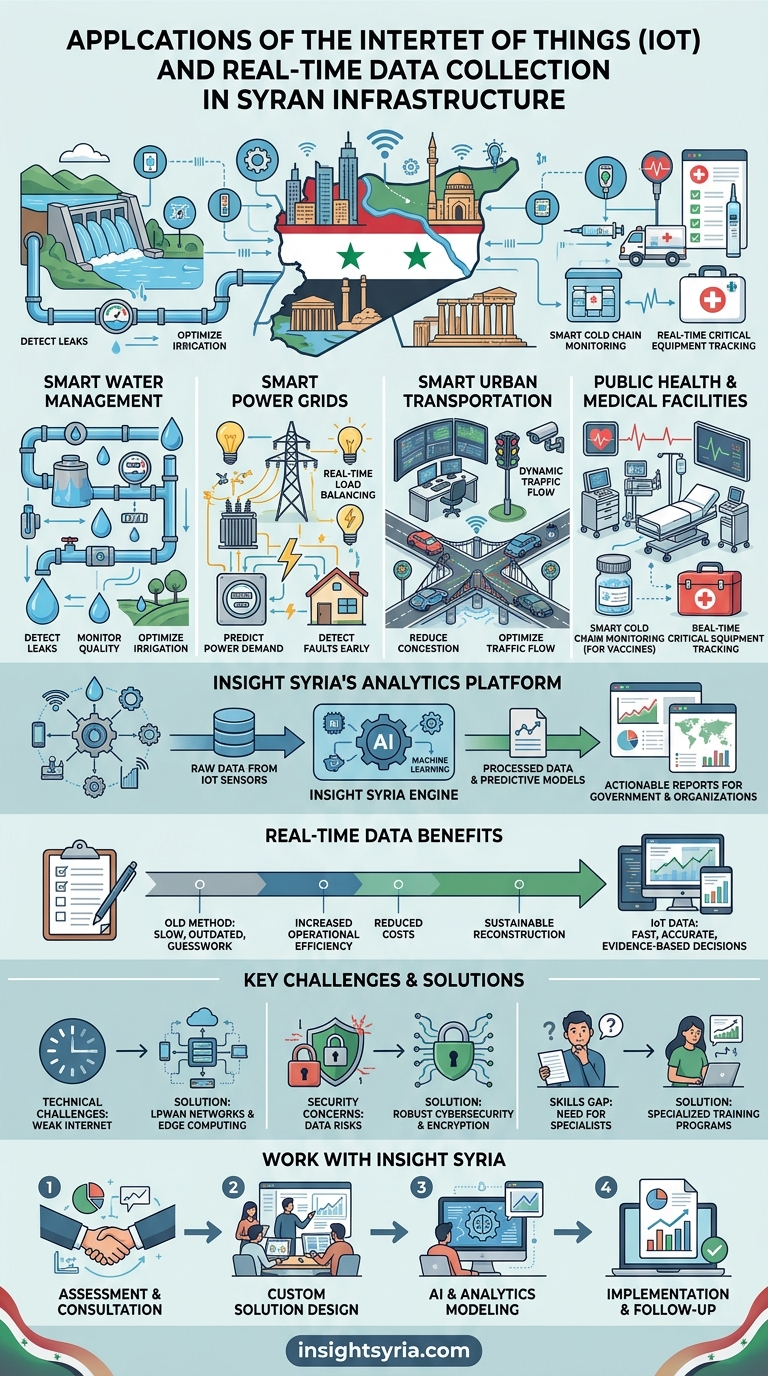
1. Water Sector Management and Irrigation Networks (Smart Water Management)
The water crisis in Syria is one of the toughest challenges facing both society and the agricultural sector. IoT technologies can provide revolutionary solutions through:
- Flow and Pressure Sensors: Installing them in main and secondary networks to monitor water leakage and waste that loses vast amounts of treated water.
- Water Quality Monitoring: Collecting live data on pollution, salinity, and chlorine levels at pumping stations to ensure the safety of water supplied to citizens.
- Well Management and Smart Irrigation: Using soil moisture sensors to collect live data that helps farmers and stakeholders rationalize groundwater consumption.
By integrating this data into the analytical platforms of “Insight Syria”, we can provide accurate reports to the international and local organizations working in the water sector (WASH), facilitating the targeting of the most drought-stricken areas and designing effective relief and developmental projects.
2. Energy and Electricity Sector (Smart Grids & Power Distribution)
The electricity sector in Syria has suffered significant destruction and a severe shortage of generation capacity, making the management of available power a matter of great precision and sensitivity.
- Microgrids: Using IoT meters and sensors to monitor live electrical loads and distribute energy fairly and efficiently among residential neighborhoods and vital facilities (hospitals, bakeries).
- Monitoring Generation Stations and High Tension Lines: Early detection of technical and thermal faults in transformers and main stations to avoid sudden and widespread power outages.
Providing this live data to governmental bodies and energy supply companies helps them anticipate peak consumption and prepare studied rationing plans that reduce citizens’ suffering and support the continuity of economic activities.
3. Transportation Infrastructure and Urban Transport (Smart Transportation)
The movement of goods and people in Syrian cities requires precise reorganization to reduce congestion, lower fuel consumption, and mitigate accidents on damaged roads.
- Live Traffic Monitoring Systems: Installing smart cameras and motion sensors to collect immediate data on traffic density on main streets and vital intersections.
- Bridge and Road Safety Assessment: Placing vibration and stress sensors on bridges and tunnels to monitor the impact of heavy loads and anticipate any cracks or structural risks before disaster strikes.
These applications enable municipal managers and local administration ministries to make quick decisions regarding bus routes, road paving priorities, and repairing damaged infrastructure based on accurate and actual usage data.
4. Public Health and Medical Facility Management
Infrastructure cannot be separated from the health sector, especially given the urgent need to improve the efficiency of hospitals and health centers in Syria.
- Smart Cold Chains: Using IoT sensors to monitor the temperatures of sensitive vaccines and serum medications during their storage and transport to avoid spoilage.
- Live Medical Resources Management: Tracking the availability of oxygen and critical equipment in hospitals in real-time, preventing sudden shortage crises.
The Role of “Insight Syria” in Empowering Governments and Organizations through Advanced Data Analytics
At “Insight Syria”, we are not just a provider of data collection services; we are strategic partners in building the future of the homeland. We understand the complexities of the Syrian landscape and have the technical, logistical, and analytical capabilities to execute the largest research projects, surveys, and field data collections.
How do we support our clients from governmental bodies and international organizations?
- Designing and Implementing Customized Data Collection Systems: Building comprehensive digital infrastructures that suit the local environment and its challenges (sometimes weak connectivity, power cuts).
- Conducting Surveys and Field Research: Integrating digital data coming from IoT sensors with community survey results to accurately understand humanitarian and service needs.
- Providing Actionable Strategic Reports: Transforming raw numbers into clear, evidence-based recommendations for managers and policymakers, thereby enhancing the efficiency of funding allocated for reconstruction and development projects.
- Transparency and Building Trust: We help international organizations and donors track their projects’ impact on the ground through live and reliable performance indicators, thereby enhancing trust and transparency in project execution.
Challenges and Solutions in Adopting IoT and Smart Infrastructure in Syria
Despite the immense benefits provided by IoT applications and live data collection in Syrian infrastructure, the implementation process faces some real challenges that must be addressed wisely and professionally:
- Technical Challenges and Communication Infrastructure:
- Problem: Sometimes weak internet networks in some affected or rural areas.
- Solution: Relying on low-power wide area network (LPWAN) technologies and edge computing that process data locally before sending it, reducing reliance on continuous and fast internet connectivity.
- Security Challenges and Data Protection:
- Problem: The sensitivity of data linked to vital infrastructure and protecting it from breaches or misuse.
- Solution: Applying the highest cybersecurity standards and encrypting data exchanged between devices and central platforms, storing it according to strict protocols that ensure privacy and reliability.
- Shortage of Specialized Human Resources:
- Problem: The need for engineers and data scientists specifically trained to handle advanced IoT technologies.
- Solution: “Insight Syria” is committed to providing specialized training programs and building the capacities of local personnel, ensuring project sustainability and generating national expertise capable of managing Syria’s technological future.
Practical Steps to Start: How to Work with “Insight Syria”?
If you represent a governmental body, an international organization, or a local institution seeking to develop your service or developmental projects in Syria, partnering with an expert team is your first step towards success. The process of collaboration with us follows a scientific and studied methodology:
- Initial Assessment and Consultation: Studying the needs of your institution and the nature of the sector you are targeting (water, energy, transport, health, or social studies).
- Designing a Customized Solution: Building a comprehensive strategy for collecting live data through IoT sensors or digital field and survey tools.
- AI Analysis and Modeling: Processing data and extracting precise indicators that reflect strengths, weaknesses, and available opportunities.
- Execution and Follow-Up: Delivering strategic reports and accompanying your team in making the right decisions and monitoring the impact of projects on the ground.
Conclusion: Towards a Digital and Sustainable Tomorrow in Syria
The journey of reconstructing Syria and building its infrastructure on modern and sustainable foundations no longer relies on human effort and randomness in planning, but has become an exact science governed by numbers, live data, and artificial intelligence algorithms. Embracing IoT applications and live data collection in Syrian infrastructure represents an unprecedented historical opportunity to reduce waste, accelerate recovery, and enhance the quality of life for citizens in every city and village.
At “Insight Syria”, we take pride in being the trusted partner for governmental bodies and organizations seeking excellence and professionalism in the field of data analytics, social and economic research, and surveys. We are here to leverage our advanced expertise in your hands to make every decision a successful investment in the future of Syria.
Let’s build the future together on a solid foundation of facts and data. Contact us today at “Insight Syria” to discover how our customized services can make a real difference in your upcoming projects.
Frequently Asked Questions
What IoT applications are implemented in Syria?
Applications are increasingly used in the sectors of water, energy, transportation, and public health.
How is data secured in IoT systems?
The best cybersecurity standards are applied along with data encryption to protect it.
What are the benefits of live data?
It helps improve response, planning, increase efficiency, and reduce operational costs.