
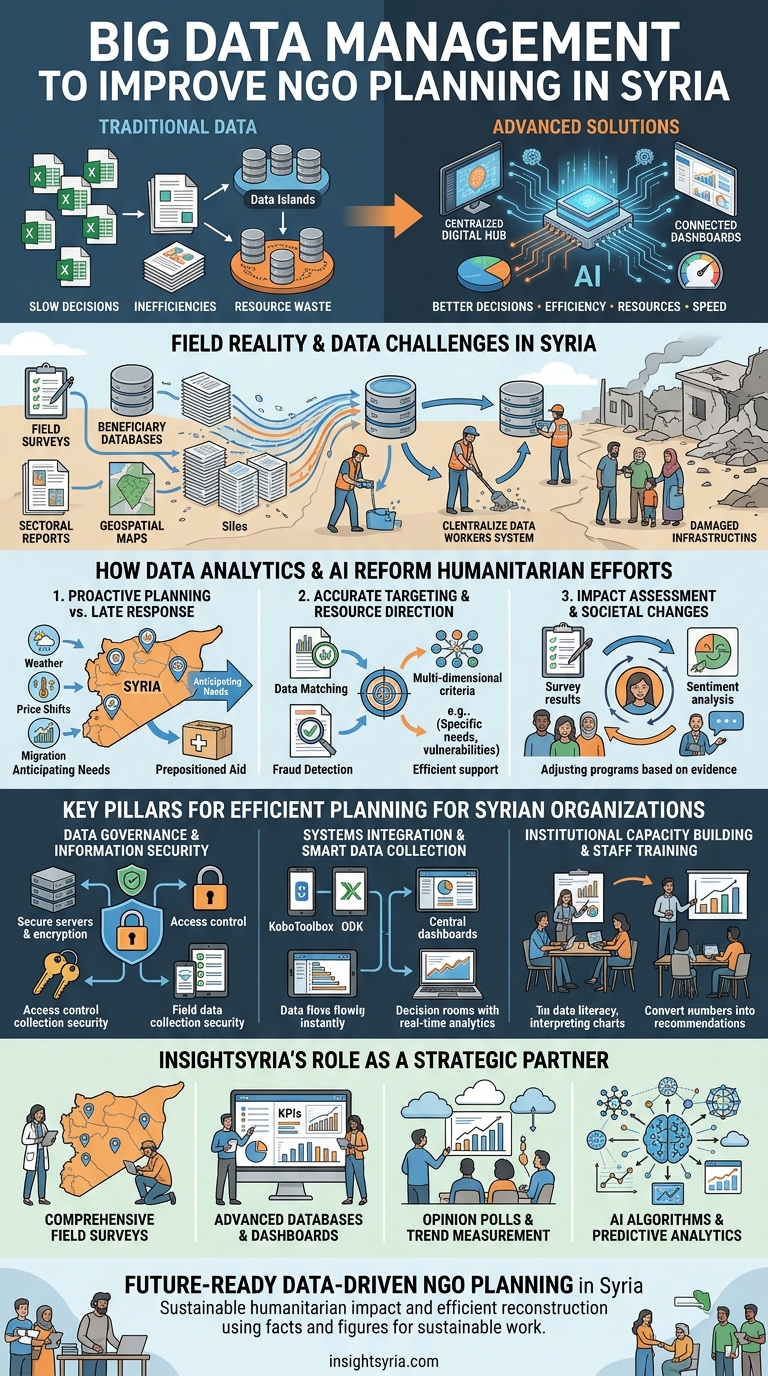
Big Data Management for NGOs in Syria: Towards More Efficient Planning
- Transitioning from traditional data management to advanced analytics and artificial intelligence solutions.
- The importance of professional data management strategies to improve decision-making processes.
- The role of data analytics and artificial intelligence in enhancing the response of humanitarian organizations.
- Providing tailored solutions that meet the needs of the Syrian context.
Table of Contents
- The Field Reality and Data Flow Challenges in the Syrian Context
- How Data Analytics and Artificial Intelligence Contribute to Redefining Humanitarian Work?
- Key Pillars Towards More Efficient Planning for Organizations in Syria
- The Role of ‘Insight Syria’ as a Strategic Partner in Research and Analysis
- The Future of Development and Humanitarian Work Driven by Data
The Field Reality and Data Flow Challenges in the Syrian Context
NGOs operate in an environment characterized by a plethora of variables and rapid changes in living and economic conditions. This reality generates thousands of records daily; field surveys, beneficiary databases, sector reports, and geographic maps.
However, the greatest challenge lies not in the “ability to collect data,” but rather in managing, cleaning, and analyzing it to extract accurate and reliable performance indicators. Often, organizations suffer from the issue of “isolated data silos,” where information is stored in separate files (Excel, local databases, paper reports) without a central system linking them together. This fragmentation deprives senior management of an overarching view, leading to delays in strategic decision-making and possibly duplicating assistance or wasting precious resources.
Thus, there is an utmost importance in adopting professional strategies for managing big data for NGOs in Syria: towards more efficient planning, as these systems allow for the integration of diverse data sources, standardization of collection criteria, and the provision of interactive dashboards that enable decision-makers to read the field scene moment by moment.
How Data Analytics and Artificial Intelligence Contribute to Redefining Humanitarian Work?
Recent years have witnessed qualitative leaps in the fields of data analytics and artificial intelligence, opening unprecedented horizons for humanitarian and developmental organizations. Modern techniques are no longer limited to simple counting and statistical enumeration; they have extended to include predictive analysis and advanced mathematical modeling.
1. Transitioning from Late Response to Proactive Planning
Traditional systems often rely on “reaction”; i.e., monitoring the crisis after it has occurred and then attempting to respond. In contrast, algorithms of artificial intelligence and big data analytics enable predicting needs before they escalate. For example, by analyzing climate patterns, price indicators, and previous displacement movements, organizations can build predictive models that accurately identify areas most at risk of food insecurity or water scarcity in the coming months, allowing for efficient aid targeting and advance preparation.
2. Targeting Beneficiaries Accurately and Directing Resources
In the face of limited funding and the increased scale of humanitarian needs in Syria, ensuring that aid reaches its rightful recipients is a matter of destiny. Advanced data analysis tools assist in intersecting databases, discovering duplications or errors in beneficiary lists, and applying multidimensional targeting criteria. This ensures transparency and accountability, and enhances the trust of donors in the efficiency of project management.
3. Impact Evaluation and Monitoring Community Changes
The role of data analytics does not stop at the planning and execution stage, but extends to measuring the actual impact of projects on the ground. Through natural language processing (NLP) techniques and sentiment analysis, organizations can read beneficiaries’ opinions and comments through digital surveys or textual field evaluations to understand their satisfaction with provided services and adjust course based on clear scientific evidence.
Key Pillars Towards More Efficient Planning for Organizations in Syria
For NGOs to reap the full benefits of managing their big data, they must follow a scientific and well-thought-out methodology consisting of several key stages:
A. Data Governance and Information Security
In the Syrian context, the confidentiality and security of individual and beneficiary data is a red line that cannot be compromised. Building an effective big data system requires establishing strict data governance policies, including access permissions, encrypting databases, and complying with best global practices in privacy protection. At “Insight Syria”, we prioritize field and digital security standards when designing any technical system or conducting any statistical survey.
B. System Integration and Smart Data Collection
Planning efficiency depends on the quality of inputs. Therefore, the transition from traditional paper surveys to modern digital data collection tools (such as KoboToolbox and ODK linked to central databases) is essential. This integration allows for real-time data flow from the field to central operation rooms, eliminating the time gap between problem occurrence and monitoring.
C. Capacity Building and Training of Personnel
Technology alone is not enough; it must be accompanied by an investment process in human resources. NGOs need personnel capable of reading data, interpreting charts, and converting numbers into clear policy or operational recommendations. Training teams on the basics of data literacy contributes to creating an institutional culture that relies on evidence and proofs at every step.
The Role of “Insight Syria” as a Strategic Partner in Research and Analysis
As a leading company based in Syria specializing in providing a comprehensive package of market research, opinion polls, and data analysis services, we fully understand the field complexities faced by governmental entities, NGOs, and international companies working in development and humanitarian affairs.
We believe that managing big data for NGOs in Syria: towards more efficient planning is not a theoretical slogan, but a practical methodology we translate daily through our research and analytical projects. Our team of experts in data science, applied statistics, and social and political researchers offers customized solutions that meet the specific needs of the Syrian context, including:
- Designing and implementing comprehensive field surveys: through a wide network of trained field researchers in various Syrian governorates.
- Developing advanced databases and dashboards: to help administrations monitor key performance indicators (KPIs) moment by moment.
- Conducting opinion polls and measuring public opinion trends: to provide precise insights that assist in shaping public policies and humanitarian and developmental intervention programs.
- Utilizing artificial intelligence algorithms and predictive analysis: to study developmental gaps and effectively plan future projects.
The Future of Development and Humanitarian Work Driven by Data
In conclusion, the rapid evolution in data analytics and artificial intelligence technologies opens the door wide for NGOs and official bodies in Syria to make a qualitative leap in the quality of their project planning and execution. Abandoning traditional methods and moving towards big data governance represents a lifeline for ensuring the sustainability of humanitarian work and maximizing the positive impact of every lira or dollar invested in the field.
Building the future of Syria requires decisions based on accurate facts and figures, not on intuition and guesswork. At “Insight Syria”, we pride ourselves on being the trusted partner that bridges advanced technology and the complex field reality, to create together a more efficient, transparent, and sustainable planning environment.
If your organization seeks to enhance its capabilities in data collection, conduct socio-economic research, or design advanced analytical systems that keep pace with current challenges and anticipate the future, our team is always ready to provide consultation and integrated solutions designed specifically to meet your needs with high precision and professionalism. Contact us today to begin the journey of digital and analytical transformation towards more efficient planning and sustainable impact.
Frequently Asked Questions
What is the importance of big data management for NGOs in Syria?
Big data management enables organizations to transform informational randomness into actionable insights, supporting better strategic decision-making and enhancing the efficiency of their humanitarian responses.
How does data analytics contribute to improving beneficiary targeting?
Data analytics assists in intersecting databases and detecting errors, ensuring that support reaches those who deserve it and enhancing transparency and accountability.
What modern data collection methods should organizations adopt?
Organizations should use digital data collection tools such as KoboToolbox and ODK, which provide real-time data flow from the field to the operation rooms.