From Data to Decisions: Why Every Organization in Syria Needs a KPI Dashboard?
- The need for effective analytical tools persists amid Syrian challenges.
- KPI dashboards facilitate decision-making based on reliable data.
- They help enhance transparency and accountability among organizations.
- They enable improved resource management and performance monitoring.
- They contribute to enhanced forecasting and risk management capabilities.
Table of Contents
- The Urgent Need for Transparency and Measurement in the Syrian Context
- Why are KPI Dashboards an Indispensable Tool for Syrian Institutions?
- Designing the Main KPI Dashboard: Syrian Specialization at “Insight Syria”
- Tangible Benefits for Various Sectors in Syria
- Challenges and Solutions: How to Overcome Data Obstacles in Syria?
- The Future of Syrian Management: Relying on Analytical Intelligence
The Urgent Need for Transparency and Measurement in the Syrian Context
Organizations operating in Syria have long faced significant challenges related to data collection in complex environments and report reliability. The current environment demands a high level of flexibility and accountability. When we talk about data analysis for strategic decision-making, we talk about reducing ambiguity and increasing certainty, which KPI dashboards effectively provide.
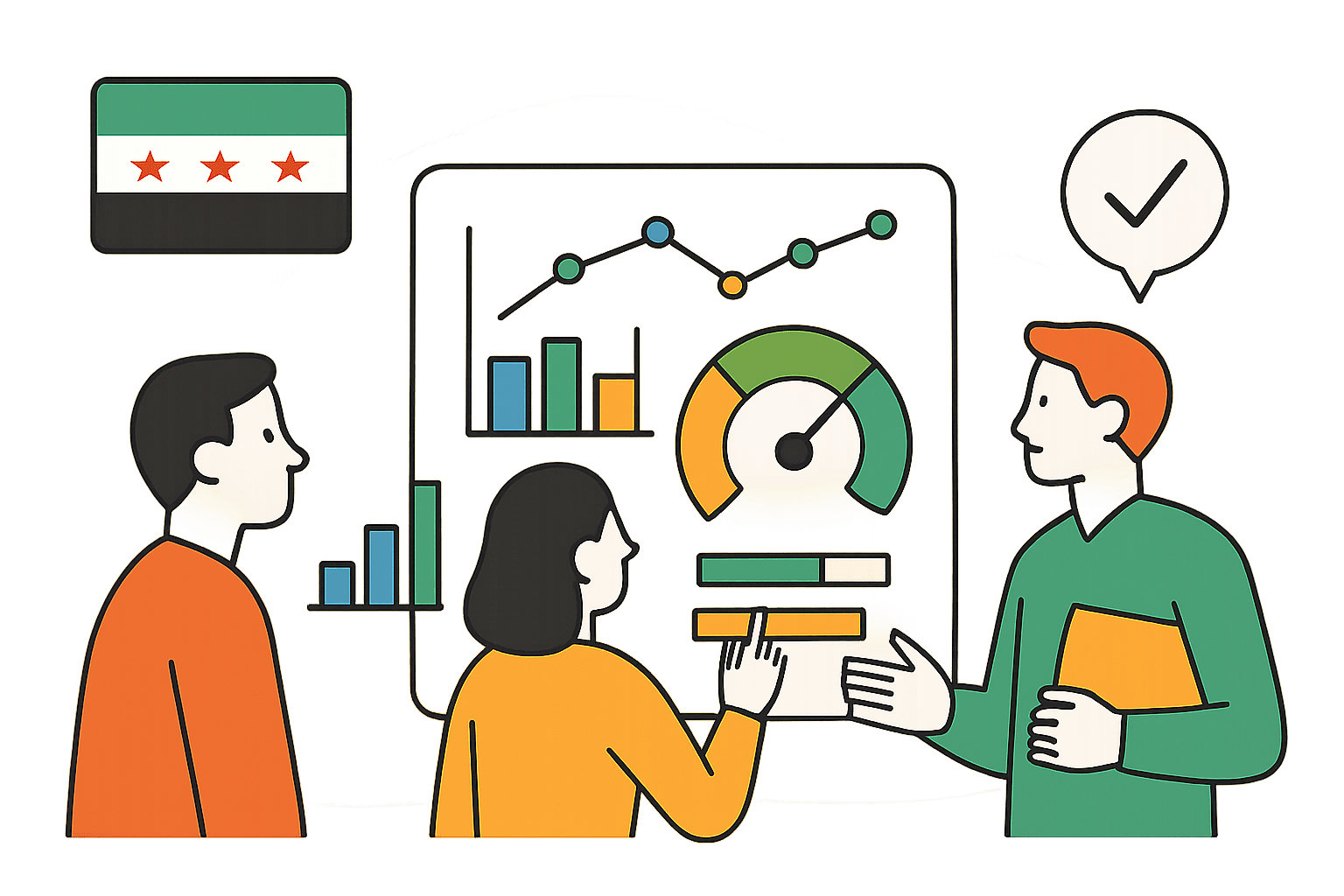
A Key Performance Indicator (KPI) Dashboard is known as a visual interface that consolidates the most important metrics and data related to specific strategic goals and presents them in an easily understood graphical format. It is not just a monthly report but a live monitoring system that supports daily management and long-term planning.
Why are KPI Dashboards an Indispensable Tool for Syrian Institutions?
With limited resources and logistical and security challenges, every decision becomes doubly important. Relying on guesswork or outdated reports can lead to wasted resources or program failures. This is where the core value of using data analysis to guide public policies and monitoring tools for project progress lies.
1. Assessment Accuracy and Impact Measurement
For NGOs and donors, proving impact achievement is the key to ongoing funding. KPI dashboards can track the KPIs of a specific program (such as the percentage of beneficiaries reached, the efficiency of aid distribution, or changes in food security indicators).
2. Forecasting and Risk Management
The Syrian environment is characterized by sudden inflection points (such as unexpected security or economic changes). Good measurement dashboards not only display the current situation but also use data trends to provide data-driven forecasting.
3. Enhancing Accountability and Transparency
Whether facing international partners or local beneficiaries, every organization needs to show how funds and efforts are being used. A KPI dashboard provides a visual, documented performance record. It supports the principle of open data and good governance, where responsibilities can be precisely determined based on specific performance indicators.
4. Supporting Government and Administrative Decisions
For government and local bodies concerned with providing public services, a KPI dashboard is a vital tool for improving services. Is the efficiency of issuing documents decreasing in a specific directorate? Are there delays in infrastructure projects? Analyzing this visual data provides the capability for quick intervention and resource allocation to improve public sector efficiency.
Designing the Main KPI Dashboard: Syrian Specialization at “Insight Syria”
Building an effective dashboard is not just a graphic design process; it is a strategic process that begins with a deep understanding of the organization’s goals and the context in which it operates. At Insight Syria, we focus on integrating our expertise in public opinion research and Syrian market trends within the dashboard-building process.
Identifying the Appropriate Key Performance Indicators (KPIs)
A common mistake is to compile “all available data.” A successful KPI dashboard focuses on “metrics that drive decisions.” This requires an accurate understanding of the difference between:
- Output Indicators: What has been achieved (e.g., number of training sessions conducted).
- Outcome Indicators: What change has this achievement brought about (e.g., percentage of graduates who found jobs within 6 months).
- Impact Indicators: Long-term change (e.g., improvement in the general income level of beneficiaries).
In the Syrian context, indicators should also include metrics related to social change dynamics and geopolitical risk analysis that may affect operations.
Integrating Diverse Data Sources
The Syrian environment requires reliance on disparate and unconventional data sources. An effective dashboard must be capable of integrating:
- Direct field survey data: Collected through our extensive network of researchers trained in advanced quantitative and qualitative research methodologies.
- Social Monitoring Data: Monitoring digital platforms and public opinions to understand societal sentiment (Sentiment Analysis).
- Micro-macro economic data: Tracking currency exchange rates, transport costs, and changes in basic commodity prices.
Our ability to integrate and analyze structured and unstructured data is what distinguishes “Insight Syria” in building comprehensive KPI dashboards.
Tangible Benefits for Various Sectors in Syria
Applying Key Performance Indicator dashboards has benefits shaped by the organization’s nature and its specific needs to transition from data to decisive decisions.
A. For the Government Sector and Public Institutions
Local governments need a unified tool to measure the performance of different departments and compare them.
- Service delivery efficiency: Tracking indicators such as the average request processing time and citizen satisfaction with public services (measured through periodic surveys integrated into the dashboard).
- Budget allocation: Using historical data trend analysis to determine where spending should be increased and where it can be reduced to ensure maximum societal benefit.
- Crisis response: A rapid measurement board that shows the most affected areas by power outages or supply shortages, facilitating immediate response.
B. For International and Humanitarian Organizations
The pressure to provide rapid and detailed reports to funders makes KPI dashboards indispensable.
- Supply chain monitoring: Tracking distribution indicators, spoilage rates, and transport costs across different regions. This is vital to ensure effective aid delivery in a challenging logistical environment.
- Community Acceptance Rate Measurement: Analyzing changes in public attitude toward specific interventions using data collected through reliable public surveys.
- Operational risk management: Proactively identifying daily operation bottlenecks.
C. For the Private Sector and Startups
In a competitive market increasingly reliant on efficiency, KPI dashboards help make smart business decisions.
- Analysis of Syrian Consumer Behavior: Integrating sales data with market insights derived from field surveys to understand pricing preferences and the most effective distribution channels.
- Marketing efficiency: Measuring Return on Investment (ROI) from various promotional campaigns (especially digital ones) based on real data rather than estimates.
- Financial performance management: Real-time monitoring of liquidity, which is crucial given currency rate fluctuations and banking challenges.
Challenges and Solutions: How to Overcome Data Obstacles in Syria?
Implementing a data analysis system for strategic decision-making in Syria faces unique challenges requiring in-depth local expertise, which “Insight Syria” offers.
Challenge 1: Data Quality and Reliability
Due to challenges in physical access and the scarcity of updated official statistics, relying on a single data source poses a significant risk.
Insight Syria’s Solution: We rely on a triangulation methodology, comparing data collected through direct surveys with available secondary data and using algorithms to assign a “confidence score” to each data point. This ensures that effective operational process monitoring is based on verified facts.
Challenge 2: Access to Technology and Analytical Tools
Advanced analytical tools can be costly or require infrastructure not readily available.
Insight Syria’s Solution: We provide an integrated service solution. Our team not only provides analysis but also designs and implements the dashboard on adaptable platforms capable of functioning even amid connection outages or limited bandwidth. This ensures the continuity of data-driven analysis.
Challenge 3: Translating Insights into Actions
Many reports end up on shelves. The importance of a measurement board is that it drives action.
Insight Syria’s Solution: Our management teams are trained to read the board and interpret warning signals. We ensure that graphs are linked to “proposed actions.” When an indicator shows a consistent decline, the board is accompanied by a direct recommendation: “Review the distribution team in area (A) immediately.” This automatically turns data into decisive decisions.
The Future of Syrian Management: Relying on Analytical Intelligence
Organizations that will thrive in the future Syrian landscape are those that adopt a culture of evidence-based decision-making. Investing in Key Performance Indicator (KPI) Dashboards is an investment in certainty within an environment marked by uncertainty.
At “Insight Syria,” we see these dashboards as the backbone of modern governance, whether they relate to aid distribution, developmental project management, or economic policy-making. They are the tool that allows managers and decision-makers to look at the big picture while retaining the ability to delve into fine details when necessary.
Our ability to integrate and analyze social and political data with traditional operational metrics provides unparalleled panoramic insights. We invite government institutions and partner organizations to reach out to us to explore how we can design a customized dashboard that begins with defining strategic objectives, through data collection in complex environments, to providing a visual interface that empowers you to lead with confidence and turn data into a driving force for success in Syria.
Transitioning from “belief” to “measurement-based knowledge” is the only way to ensure the sustainability of efforts and achieve desired goals in this exceptional context. Leveraging our expertise in public opinion research and Syrian market trends to calibrate your indicators means you are choosing the most efficient and effective path.
Frequently Asked Questions
What is a Key Performance Indicator (KPI) Dashboard?
It is an analytical tool that consolidates important data and metrics related to specific strategic goals and displays them visually.
Why does the non-profit sector in Syria need KPI Dashboards?
To enhance transparency, ensure efficient use of resources, and achieve optimal outcomes.
How do KPI Dashboards contribute to Risk Management?
They use current trends to anticipate and identify potential problems early, allowing for rapid response.
What are the main challenges of implementing KPI Dashboards in Syria?
They include data quality, access to technology, and translating insights into actions.