Beyond Profits: Key Performance Indicators for Measuring the Social Impact of Initiatives in Syria
- Moving beyond traditional financial returns to assess the value of projects in the Syrian market
- Applying performance indicators related to the transformative sustainability of various initiatives
- Addressing methodological challenges in measuring social impact within the Syrian work environment
- Using data analysis tools to support decision-makers and improve project effectiveness
- Real-world experiences and practical models under the Insight Syria umbrella
Table of Contents
- Why Do We Need to Measure Social Impact in the Syrian Context?
- Methodological Challenges in Evaluating Impact in the Local Environment
- Key Performance Indicators (KPIs) for Measuring Social Impact: A Comprehensive Framework
- The Role of Advanced Data Analysis in Enhancing the Credibility of Initiatives
- Case Studies and Practical Examples from the Syrian Reality
- How Does Insight Syria Help Your Organization Achieve Sustainable Impact?
- Conclusion: Towards an Evidence-Based Future
Why Do We Need to Measure Social Impact in the Syrian Context?
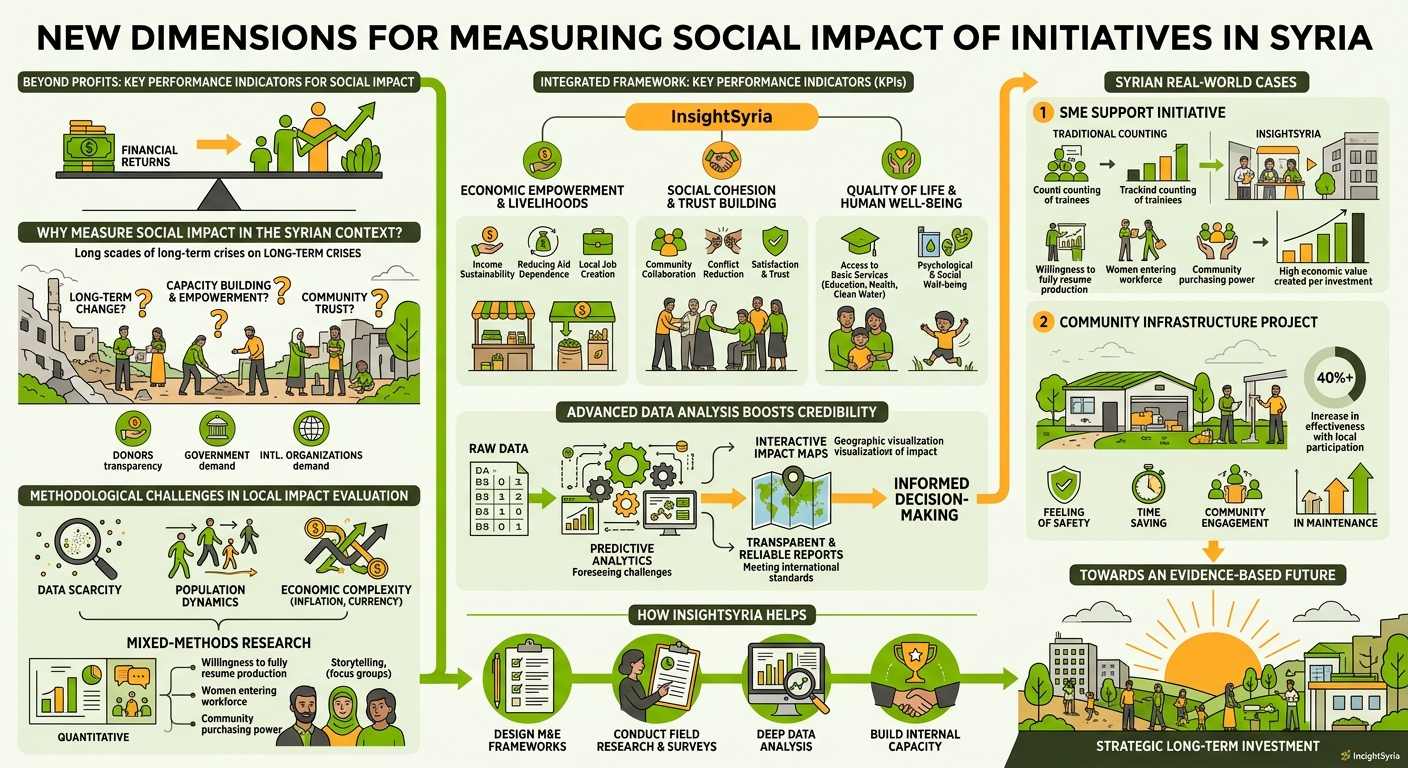
Development, humanitarian, and business initiatives with a community dimension in Syria face unique challenges. Local communities are recovering from the repercussions of prolonged crises, along with structural changes in the economic and social fabric. When we talk about Beyond Profits: Key Performance Indicators for Measuring the Social Impact of Initiatives in Syria, we do not mean just tracking the number of beneficiaries, but we are asking much deeper questions:
- How has this initiative changed the lives of individuals, families, and the community in the long term?
- Has it contributed to building real capacities and empowering the most vulnerable groups?
- What is the level of community trust built through these projects?
Donors, government ministries, and international organizations are now demanding transparent, measurable standards that prove that the allocated resources achieve their actual developmental returns. Here comes the role of “Insight Syria” in providing accurate scientific methodologies for data collection, analysis, and delivering strategic insights that help these entities make informed, evidence-based decisions.
Methodological Challenges in Evaluating Impact in the Local Environment
Measuring social impact undoubtedly faces methodological and practical obstacles anywhere in the world, but these challenges are multiplied in the Syrian context. Some of the main challenges include:
- Lack of accurate and updated data: Markets and communities often suffer from a lack of unified databases, necessitating reliance on direct fieldwork and carefully designed surveys.
- Population movement dynamics: Ongoing demographic changes and the return or movement of displaced persons create challenges in tracking beneficiaries over a long period.
- Economic complexity: The interplay of inflation, currency fluctuations, and market access makes it necessary to use advanced statistical analysis methodologies to separate the impact resulting from the initiative alone from external factors.
To overcome these challenges, “Insight Syria” relies on mixed methods research methodologies, combining precise quantitative data analysis that provides numbers and ratios with in-depth qualitative research that delves into success stories, challenges, and real human experiences of beneficiaries.
Key Performance Indicators (KPIs) for Measuring Social Impact: A Comprehensive Framework
To shift from theory to practical application, we must design key performance indicators (KPIs) specifically tailored to meet the goals of each initiative. When designing these indicators under the framework of Beyond Profits: Key Performance Indicators for Measuring the Social Impact of Initiatives in Syria, we usually focus on several key areas:
1. Indicators of Economic Empowerment and Livelihoods
Measuring the success of economic empowerment projects is not limited to the number of loans granted or the number of training workshops conducted; it extends to include:
- Income sustainability: The percentage of beneficiaries who maintained stable sources of income at least six months after the conclusion of the initiative.
- Reducing dependency on aid: The gradual transition rate for beneficiary families from receiving aid to partial or full self-sufficiency.
- Creating local job opportunities: The number of sustainable jobs created within the local community as a result of the project.
2. Indicators of Social Cohesion and Trust Building
In communities emerging from crises, social capital is a vital element for recovery. The indicators here include:
- Level of community cooperation: Measuring the extent of various segments of the community participating in local decision-making activities.
- Reducing local conflicts: Monitoring indicators of reduced community tensions through periodic surveys.
- Level of satisfaction and trust: Evaluating how much trust beneficiaries have in implementing entities and the initiatives provided.
3. Indicators of Quality of Life and Human Well-being
These indicators target direct human aspects, such as:
- Access to basic services: The extent to which targeted households have improved access to education, healthcare, and clean water.
- Psycho-social well-being: Using established scientific measures to assess decreases in stress levels and feelings of safety and psychological stability among targeted groups, especially children and women.
The Role of Advanced Data Analysis in Enhancing the Credibility of Initiatives
Data collection is just the first step; the real magic lies in how to transform this data into actionable insights. As a team comprising experts in data science and statistical analysis at “Insight Syria,” we utilize advanced modeling tools and smart techniques to analyze patterns and trends.
When government institutions and international organizations collaborate with us, they do not just receive traditional reports; they get:
- Predictive Analytics: Helps anticipate future challenges for the initiative before they occur, enabling timely course corrections.
- Interactive impact maps: Precisely illustrate where initiatives achieve the highest impact and where additional interventions are needed.
- Transparent and reliable reports: Meet international donor standards and enhance the confidence of regulatory and governmental entities in operational efficiency.
This deep analytical capability empowers decision-makers to direct financial and human resources toward the most needy points, enhancing spending efficiency and multiplying the social return for every Syrian pound invested.
Case Studies and Practical Examples from the Syrian Reality
To illustrate how the concept of Beyond Profits: Key Performance Indicators for Measuring the Social Impact of Initiatives in Syria translates into reality, let us review two hypothetical models inspired by our fieldwork environment:
Model One: Initiative to Support Small and Medium Enterprises (SMEs)
An international organization funded a training and financial program for artisans affected in the countryside of a Syrian governorate. The traditional methodology would have considered only the number of trainees. However, in collaboration with our team, a measurement system was designed to monitor:
- The extent to which workshops returned to full production capacity.
- The percentage of women who entered the labor market as project owners or fair wage workers.
- The project’s impact on improving the purchasing power of families surrounding the workshop.
Result: Analysis showed that every 1 dollar invested in technical support generated community economic value estimated at double the original figure, with a noticeable increase in the stability of beneficiary families.
Model Two: Community Development Project to Improve Micro-infrastructure
In another project aimed at rehabilitating vital community facilities, survey tools were used to measure the “Community Satisfaction Index” before and after the project. The data did not only focus on asphalt quality or water networks but included:
- Residents’ feeling of security while children move to schools.
- Reduced time wasted in obtaining daily services.
- The extent of local community involvement in the maintenance and sustainability of these facilities.
Result: The data provided the organization with compelling evidence that involving the local community in planning stages increased the efficiency and sustainability of the project by more than 40%.
How Does “Insight Syria” Help Your Organization Achieve Sustainable Impact?
At “Insight Syria,” we believe every successful initiative starts with the right question and ends with accurate analysis. If you represent a government entity, a non-governmental organization, or a private sector company planning to launch a project with social dimensions in Syria, we leverage our accumulated expertise to offer you:
- Designing Impact Measurement Frameworks (M&E Frameworks): Building customized performance indicators designed to precisely match your objectives and the context of your work.
- Conducting field research and surveys: Accessing the field with trained teams and modern research tools ensuring the accuracy and reliability of collected data.
- In-depth data analysis: Transforming raw numbers into clear, actionable strategies that support your position before donors and partners.
- Building internal capacities: Training your teams on best practices in data collection and monitoring sustainable impact.
Conclusion: Towards an Evidence-Based Future
The shift towards real social impact measurement is not merely an administrative luxury but a long-term strategic investment that ensures the longevity and effectiveness of initiatives in a challenging and opportunity-laden environment like the Syrian market. By diving into Beyond Profits: Key Performance Indicators for Measuring the Social Impact of Initiatives in Syria, we can all build a more sustainable, equitable, and effective future.
If you wish to elevate your upcoming initiatives and ensure the highest levels of transparency and efficiency while achieving real, tangible impact on the ground, the “Insight Syria” team is ready to be your trusted partner in the journey towards truth, data, and sustainable impact. Contact us today to start crafting your next success based on solid and accurate scientific foundations.
Frequently Asked Questions
What are Key Performance Indicators (KPIs)?
Key Performance Indicators are metrics used to assess the overall success of an initiative based on pre-defined objectives.
How can “Insight Syria” improve my initiative’s impact?
We provide support in data collection, analysis, and designing strategies to achieve the highest possible impact for your initiatives.
What are the main challenges in measuring social impact in Syria?
Challenges include a lack of accurate data, ongoing population movements, and economic complexities.