
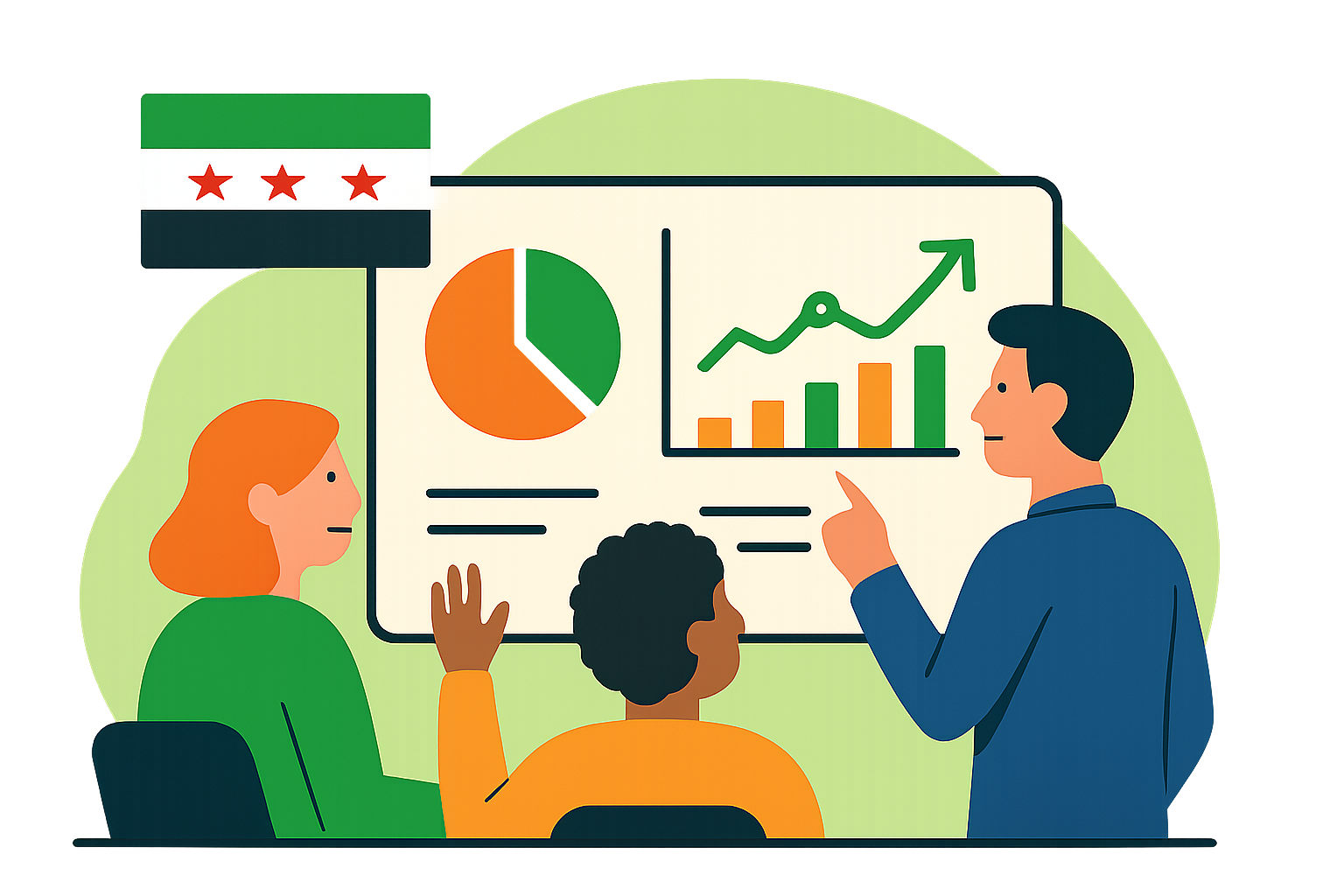
The Power of Data in Leadership: How Can Leaders Use Dashboards to Motivate and Empower Their Teams in Syria’s Complex Environment?
- Data-driven leadership tools enhance transparency and trust.
- Dashboards enable leaders to be proactive in decision-making.
- Empowering teams requires clarity in goals and metrics.
- The challenges of the Syrian context require specialized handling of data.
- Turning data into stories motivates teams and enhances performance.
Table of Contents
- The Role of Dashboards as the “Nervous System” of Effective Leadership
- Enhancing Transparency and Building Institutional Trust
- Transforming from Reactive to Proactive Management
- Empowering Teams through Clear Vision for Accountability and Performance
- Clearly Defining Goals and Metrics
- Culture of Fair and Objective Accountability
- Leveraging Advanced Analytics to Increase Team Engagement
- Using Diagnostic Analysis to Deepen Understanding
- Motivating through Exploring Future Scenarios
- Specific Challenges of the Syrian Context and How to Overcome Them with Data
- Unifying Disparate Data Sources
- Designing User-Friendly Dashboards
- Data-Led Leadership: From Monitoring to Inspiration
- Turning Data into Actionable Stories
- Measuring Social and Political Impact
The Role of Dashboards as the “Nervous System” of Effective Leadership
Dashboards act as a digital command center that brings together key performance indicators (KPIs) into one visible and understandable place. This instant visual representation radically changes decision-making. For leaders in Syria, who deal with disrupted supply chains, sudden economic shifts, and rapid demographic changes, the ability to see both the “big picture” and the “fine details” simultaneously is vital.
Enhancing Transparency and Building Institutional Trust
Open data is the foundation of trust. When leaders share performance data clearly through an easily accessible dashboard, they send a strong message to the teams: “We trust you, and we rely on your contributions.”
How can leaders use dashboards to motivate and empower their teams begins with applying transparency in measurement. In the Syrian work context, where resources may be limited and efforts doubled, employees need to know exactly where their efforts are going. If the dashboard clearly displays progress in a specific relief project or the efficiency of a local product supply chain, this reduces ambiguity and increases the sense of belonging to the mission.
At “Insight Syria”, we focus our dashboard design on making metrics related to processes and outcomes clear to everyone, ensuring that every individual understands how their daily work impacts the broader organizational goals. This transparency serves as a strong motivational factor on its own.
Transforming from Reactive to Proactive Management (Proactive Management)
Relying on monthly paper reports or delayed data forces leaders to work in a reactive mode. In contrast, dashboards provide real-time or near real-time analysis, which makes a big difference in rapidly changing environments.
A leader with an integrated dashboard can monitor emerging trends – whether it be changes in consumer sentiment based on quick surveys conducted by “Insight Syria”, or a sudden rise in prices of key production inputs. This enables them to intervene early to correct the course before the problem turns into a crisis.
How can leaders use dashboards to motivate and empower their teams by clearly defining “warning signals”. When the dashboard is set to signal a color change from green to yellow, the concerned work teams are immediately activated, not based on direct top-down instructions, but based on a reliable visual cue. This grants small teams the authority to make quick, independent decisions within a defined scope.
Empowering Teams through Clear Vision for Accountability and Performance
Empowerment does not only mean granting authority, but it means providing individuals with the tools and information necessary to use that authority effectively. Dashboards are the optimal tool to achieve this.
Clearly Defining Goals and Metrics (Goal Alignment)
Motivation thrives when the employee knows exactly what is required of them, and how their success will be measured. An excellent dashboard connects every individual or team task to the overall strategic goal of the institution.
How can leaders use dashboards to motivate and empower their teams by creating “customized dashboards”. Instead of flooding the sales team with HR data, they get a dashboard displaying: conversion rate, average deal value, and market coverage in their specific geographic areas. This focus makes the goals measurable and tangible.
In the field of market research and political analysis in Syria, precision is often required in tracking complex variables (such as the level of trust in a particular institution, or the impact of sanctions on a specific sector). Dashboards allow us to display these complex outcomes in a simplified way, enabling analysts to understand where to focus their interpretative efforts next.
Culture of Fair and Objective Accountability
In work environments that rely on personal relationships or subjective estimates, evaluation and motivation decisions can be affected by biases. The objective data provided by dashboards removes this ambiguity and makes accountability fair.
Leaders can use these tools to display expected performance versus actual performance impersonally. When a goal is achieved, it is acknowledged with data. And when a team’s performance lags, the discussion is based on numbers, not personal guesswork. This type of accountability is the foundation for a healthy and motivating work environment, where actual effort and tangible results are rewarded.
Leveraging Advanced Analytics to Increase Team Engagement
The new generation of leaders and work teams in Syria expect powerful analytical tools that go beyond merely displaying historical data. Predictive and diagnostic analytics are key to motivation based on future vision.
Using Diagnostic Analysis to Deepen Understanding
Dashboards should not only tell us *what* happened, but they should help us understand *why* it happened. The diagnostic analysis integrated into the dashboard, which can be designed by data experts at “Insight Syria”, helps teams dive into the root causes of problems.
For example, if a survey dashboard shows a decline in general satisfaction with a certain government service, the dashboard should lead the leader and their team directly to the sub-data explaining this decline (such as: the type of complaint, the affected geographical area, or the most affected population segment). This seamless transition from the general indicator to the specific cause enables the team to identify the required corrective action with high precision.
Motivating through Exploring Future Scenarios (What-If Analysis)
To achieve a high level of empowerment, employees need to see how their decisions today can shape the future. Advanced dashboards allow leaders and teams to simulate the impact of different decisions (What-If Analysis).
How can leaders use dashboards to motivate and empower their teams by building hypothetical scenarios? Imagine a team responsible for aid distribution. The dashboard can allow them to change variables like: “What happens to distribution efficiency if we increase the number of trucks by 20%?” or “What is the impact on the beneficiary base if eligibility criteria are slightly changed?” When the team can “play” with the data to see future outcomes, they become active partners in shaping the strategy, creating a level of motivation that cannot be achieved through direct orders.
Specific Challenges of the Syrian Context and How to Overcome Them with Data
Applying these concepts requires a deep understanding of the field reality in Syria, an area where “Insight Syria” specializes. Data in this context is often fragmented, heterogeneous, and subject to security and logistical constraints.
Unifying Disparate Data Sources (Data Silo Integration)
One of the biggest challenges is that information comes from multiple sources (field surveys, available official data, regional reports, social media data, etc.). Effective dashboards are those that integrate and purify these conflicting data to produce a single reliable source of truth.
Leaders relying on **social and political data analysis** need a comprehensive view. A dashboard that combines public opinion survey data on youth participation in elections (from our field data) and internal displacement data (from humanitarian sources) can help decision-makers understand the complex causal relationship between various factors. This integration enables leaders to give directions that reflect a true understanding of Syria’s multi-dimensional scenario.
Designing User-Friendly Dashboards (Usability and Accessibility)
To achieve motivation, the tool must be easy to use for everyone, not just for data scientists. The design language should be simple and straightforward.
How can leaders use dashboards to motivate and empower their teams through attention to design? We focus on using visuals that speak for themselves. Clear colors, familiar symbols, and avoiding unnecessary 3D graphics ensure that the busy field manager or government official with limited time can grasp the main points in less than a minute. This harmony between the need for depth and the necessity for speed is the key to the success of measurement tools in the Syrian environment.
Data-Led Leadership: From Monitoring to Inspiration
In conclusion, dashboards transform from being merely a monitoring tool into an inspiration catalyst when used correctly. They enable leaders to move teams from a state of “working hard” to a state of “working smart and effectively”.
Turning Data into Actionable Stories (Data Storytelling)
Data alone does not motivate; stories do. Outstanding leaders do not just display numbers on a dashboard; they use these numbers to tell a story of success or a challenge that needs to be overcome.
When a leader displays a dashboard showing that a certain team has reduced emergency response time by 40% compared to the previous quarter (and this is visually documented), they do not just commend the results; they narrate a story of heroism by the team. This type of narrative, supported by strong digital evidence, is ingrained in the teams’ memory and becomes a model to follow, enhancing a high-performance culture.
Measuring Social and Political Impact (Measuring Non-Market Impact)
For organizations working in the social or political field in Syria, success is not only measured by profits or operational efficiency, but by actual impact on communities.
How can leaders use dashboards to motivate and empower their teams in this field? By designing indicators to track “soft impact”. This includes indicators such as increased community participation in local dialogues, reduced negative rumors in an area (measured by social media analysis), or improved mutual trust levels between different population groups. When the team sees that their work leads to tangible positive results on the social fabric, the motivation to work goes beyond salary to become a moral and national drive.
At “Insight Syria”, we believe that integrating deep qualitative analysis with quantitative data in a single dashboard is the key to understanding the holistic Syrian scenario. This enables leaders to identify strengths in their teams to invest in, and determine areas that need training support or additional resources, ensuring that every step taken is informed and directed towards a specific goal. Effectively using dashboards is central to empowered leadership in the twenty-first century and is a strategic weapon in the hands of leaders seeking to move forward in Syria’s complex environment.
Frequently Asked Questions
What is a dashboard and why is it important?
A dashboard is a visual tool that combines data and performance indicators to help leaders make informed decisions. It is important because it enhances transparency and proactivity in operations.
How can leaders ensure the effectiveness of dashboards?
They can ensure this by designing dashboards to be intuitive, easy to use, and containing relevant data and essential performance metrics.
What challenges may leaders face in using dashboards?
Among the challenges: gathering data from multiple sources, ensuring data accuracy, and presenting information in a quickly understandable way.